Medical coding and medical billing are two of the most critical components of the healthcare revenue cycle. Although the terms are often used interchangeably, they represent two distinct processes that work together to ensure healthcare providers receive accurate and timely reimbursement for the services they deliver.
Whether you operate a private practice, specialty clinic, urgent care center, behavioral health organization, or multi-specialty medical group, understanding the difference between medical coding vs medical billing is essential for improving claim accuracy, reducing denials, increasing clean claim rates, and maximizing revenue cycle performance.
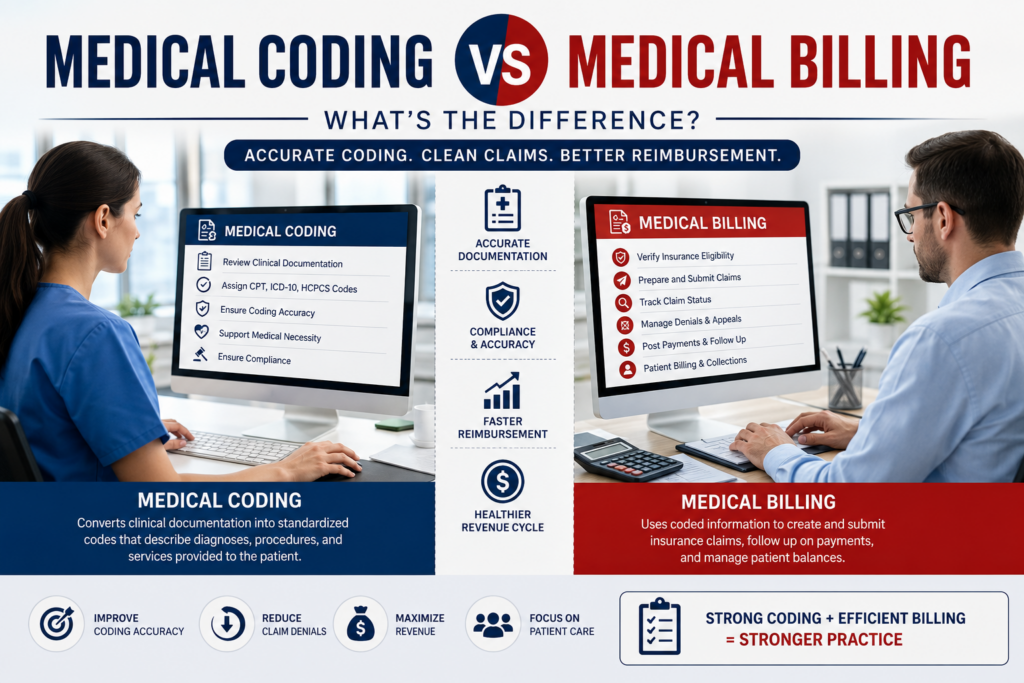
Accurate medical coding and billing directly impact insurance reimbursements, compliance, patient satisfaction, and the financial health of every healthcare organization. Coding converts clinical documentation into standardized codes, while billing transforms those codes into insurance claims submitted to Medicare, Medicaid, and commercial insurance companies.
This comprehensive guide explains the differences between medical coding and medical billing, how each process contributes to healthcare revenue cycle management (RCM), and why many healthcare providers outsource both functions to experienced medical billing companies like USA MedWorks.
What Is Medical Billing?
Medical billing is the administrative process of preparing, submitting, tracking, and following up on healthcare claims submitted to insurance companies for reimbursement. Medical billers act as the bridge between healthcare providers, insurance carriers, and patients to ensure services rendered are reimbursed accurately and efficiently.
The medical billing process begins after patient care has been documented and coded. Billers review coded claims, verify payer requirements, submit claims electronically, monitor claim status, resolve denials, post payments, and collect outstanding balances.
Primary Responsibilities of a Medical Biller
- Insurance eligibility verification
- Patient registration review
- Claim preparation and submission
- Electronic claim processing
- Payment posting
- Insurance claim follow-up
- Denial management
- Appeal submission
- Accounts Receivable (AR) management
- Patient billing and collections
The primary goal of medical billing is to ensure healthcare providers receive maximum reimbursement while maintaining compliance with payer guidelines and healthcare regulations.
What Is Medical Coding?
Medical coding is the process of translating physician documentation, diagnoses, procedures, treatments, and medical services into standardized alphanumeric codes recognized by insurance companies and government healthcare programs.
Certified medical coders review clinical documentation and assign the correct CPT®, ICD-10-CM, and HCPCS Level II codes based on official coding guidelines. These codes communicate the patient’s diagnosis, services performed, and medical necessity for reimbursement purposes.
Accurate coding ensures providers are reimbursed appropriately while reducing claim denials and maintaining compliance with CMS and payer regulations.
Primary Responsibilities of a Medical Coder
- Review physician documentation
- Assign CPT procedure codes
- Assign ICD-10 diagnosis codes
- Assign HCPCS Level II codes when applicable
- Apply medical billing modifiers
- Verify coding accuracy
- Ensure documentation supports billed services
- Maintain coding compliance
- Stay updated on annual coding changes
- Support audit readiness
Without accurate coding, even perfectly submitted insurance claims may be rejected or denied due to documentation inconsistencies or coding errors.
Medical Coding vs Medical Billing: Key Differences
Although medical coding and billing are closely connected, they perform different functions within the healthcare revenue cycle.
| Medical Coding | Medical Billing |
|---|---|
| Converts documentation into standardized codes. | Converts coded services into insurance claims. |
| Focuses on clinical documentation. | Focuses on reimbursement. |
| Assigns CPT, ICD-10, and HCPCS codes. | Submits claims to insurance companies. |
| Ensures coding accuracy. | Ensures claim accuracy. |
| Supports medical necessity. | Tracks claim status and payments. |
| Reduces coding errors. | Reduces billing denials. |
| Performed by certified medical coders. | Performed by medical billing specialists. |
While coders and billers have different responsibilities, they must work together to ensure accurate claim submission and successful reimbursement.
How Medical Coding Impacts Medical Billing
Medical coding is the foundation of the billing process. Every insurance claim depends on accurate coding before it can be submitted for reimbursement.
If a coder selects an incorrect diagnosis code, applies the wrong procedure code, or omits a required modifier, the resulting claim may be rejected, denied, underpaid, or flagged for audit.
Common coding issues affecting billing include:
- Incorrect CPT codes.
- Outdated ICD-10 diagnosis codes.
- Missing modifiers.
- Duplicate coding.
- Unbundled procedures.
- Medical necessity conflicts.
- Incomplete provider documentation.
- Incorrect place of service (POS) codes.
Improving coding accuracy leads directly to higher clean claim rates, faster reimbursements, and lower denial percentages.
Why Medical Coding and Medical Billing Are Both Essential to Revenue Cycle Management
Medical coding and billing are two interconnected components of Revenue Cycle Management (RCM). Neither process can function effectively without the other.
A simplified healthcare revenue cycle typically follows these steps:
- Patient scheduling
- Insurance eligibility verification
- Patient registration
- Medical documentation
- Medical coding
- Charge entry
- Medical billing
- Claim submission
- Payment posting
- Denial management
- Accounts Receivable follow-up
- Patient collections
Each stage depends on the successful completion of the previous step. A weakness in coding often creates billing errors, while poor billing workflows can delay reimbursement even when coding is accurate.
Common Challenges in Medical Coding and Billing
Healthcare organizations face numerous operational challenges that affect both coding accuracy and billing performance.
| Challenge | Potential Impact |
|---|---|
| Incomplete documentation | Claim denials |
| Coding inaccuracies | Reduced reimbursement |
| Insurance eligibility issues | Rejected claims |
| Missing prior authorization | Denied services |
| Incorrect modifiers | Bundled procedures |
| Provider credentialing delays | Payment delays |
| Late claim submission | Timely filing denials |
| Poor denial management | Revenue leakage |
Healthcare providers that implement standardized coding and billing workflows can significantly improve operational efficiency while reducing revenue leakage.
Benefits of Accurate Medical Coding and Billing
Practices that prioritize coding accuracy and billing efficiency experience measurable improvements across their revenue cycle.
- Higher clean claim rates
- Faster insurance reimbursements
- Lower denial rates
- Improved coding compliance
- Reduced Accounts Receivable (AR)
- Better cash flow
- Improved patient satisfaction
- Enhanced audit readiness
- Reduced administrative workload
- Stronger overall Revenue Cycle Management (RCM)
Investing in professional medical coding and billing processes helps healthcare providers reduce operational risk while maximizing reimbursement and long-term financial stability.
“`htmlCPT vs ICD-10 vs HCPCS: Understanding the Different Code Sets
One of the most common sources of confusion in healthcare administration is understanding the role of CPT, ICD-10-CM, and HCPCS Level II codes. These standardized code sets work together to describe the patient’s diagnosis, the services performed, and the supplies or equipment provided during treatment.
Accurate use of these code sets is essential for medical coding, medical billing, healthcare compliance, and successful reimbursement.
| Code Set | Purpose | Example |
|---|---|---|
| CPT® | Reports medical procedures and professional services. | 99214 – Established Patient Office Visit |
| ICD-10-CM | Reports diagnoses and medical conditions. | E11.9 – Type 2 Diabetes Mellitus Without Complications |
| HCPCS Level II | Reports supplies, medications, DME, ambulance services and certain non-physician services. | J1100 – Injection, Dexamethasone |
A complete insurance claim generally contains all three coding systems working together. The ICD-10 diagnosis establishes medical necessity, CPT identifies the service performed, and HCPCS captures eligible supplies or medications when applicable.
Common Medical Coding Errors That Lead to Claim Denials
Even small coding mistakes can result in delayed reimbursements, payer audits, underpayments, or denied claims. Healthcare organizations should implement regular coding audits to reduce these preventable errors.
Common medical coding errors include:
- Using outdated CPT or ICD-10 codes.
- Selecting diagnosis codes without sufficient specificity.
- Upcoding services to higher reimbursement levels.
- Undercoding procedures, resulting in lost revenue.
- Incorrect modifier usage.
- Duplicate coding.
- Unbundling procedures that should be billed together.
- Failure to support medical necessity with documentation.
- Coding from incomplete provider documentation.
- Ignoring National Correct Coding Initiative (NCCI) edits.
Routine coding education, internal audits, and certified professional coders help minimize these risks while improving coding accuracy and reimbursement performance.
Common Medical Billing Errors
While coding errors affect reimbursement, billing errors can delay or completely prevent payment even when coding is accurate.
Common medical billing mistakes include:
- Incorrect patient demographic information.
- Insurance eligibility verification failures.
- Missing prior authorizations.
- Incorrect payer selection.
- Late claim submission.
- Duplicate claim submission.
- Incorrect provider NPI information.
- Payment posting errors.
- Poor denial management.
- Delayed Accounts Receivable (AR) follow-up.
Combining accurate coding with efficient billing workflows dramatically improves clean claim rates and first-pass claim acceptance.
Why Healthcare Practices Outsource Medical Coding and Billing
Many physician practices, hospitals, behavioral health organizations, urgent care centers, and specialty clinics outsource medical coding and billing to improve operational efficiency and maximize reimbursements.
Outsourcing provides access to experienced billing professionals, certified coders, advanced billing technology, and dedicated revenue cycle specialists without the expense of maintaining a large in-house team.
Benefits of outsourcing include:
- Certified Professional Coders (CPC).
- Experienced medical billing specialists.
- Improved coding accuracy.
- Reduced claim denial rates.
- Higher clean claim percentages.
- Faster insurance reimbursements.
- Improved compliance with CMS and payer regulations.
- Dedicated denial management.
- Accounts Receivable (AR) follow-up.
- Monthly revenue cycle reporting.
- Lower administrative costs.
- Scalable billing support as your practice grows.
Outsourcing allows providers to spend more time delivering quality patient care while experienced billing professionals manage the complexities of reimbursement.
How USA MedWorks Supports Medical Coding and Billing
At USA MedWorks, we provide comprehensive medical billing and coding solutions designed to improve reimbursement accuracy, strengthen compliance, and optimize every stage of the revenue cycle.
Our services include:
- Medical Billing Services
- Revenue Cycle Management (RCM)
- Medical Coding Services
- Insurance Eligibility Verification
- Prior Authorization Support
- Credentialing and Provider Enrollment
- Accounts Receivable (AR) Management
- Denial Management and Appeals
- Payment Posting
- Compliance Audits and Reporting
By combining certified coding expertise with experienced billing professionals, USA MedWorks helps healthcare organizations improve financial performance while remaining compliant with payer and regulatory requirements.
Internal Resources
- Medical Billing Services
- Revenue Cycle Management (RCM) Services
- Medical Billing & Coding Services
- Provider Credentialing Services
- Mental Health Billing Services
- Request a Free Consultation
Helpful External Resources
- Centers for Medicare & Medicaid Services (CMS)
- AAPC
- American Health Information Management Association (AHIMA)
- American Medical Association (AMA)
Frequently Asked Questions
What is the difference between medical coding and medical billing?
Medical coding converts clinical documentation into standardized CPT, ICD-10, and HCPCS codes, while medical billing uses those codes to prepare, submit, and manage insurance claims for reimbursement.
Can medical coding exist without medical billing?
No. Medical coding and medical billing are interconnected processes. Accurate coding is essential for creating compliant insurance claims, while medical billing ensures those claims are submitted, tracked, and reimbursed correctly.
Which comes first: coding or billing?
Medical coding always comes before medical billing. Healthcare providers document patient care, coders assign standardized codes, and billers then use those codes to submit claims to insurance payers.
Why is coding accuracy important?
Accurate coding reduces claim denials, improves reimbursement, supports regulatory compliance, minimizes audit risk, and strengthens the overall revenue cycle.
Should healthcare practices outsource medical coding and billing?
Many practices outsource coding and billing to improve efficiency, reduce overhead, access certified experts, improve collections, lower denial rates, and optimize revenue cycle management.
Conclusion
Understanding the differences between medical coding vs medical billing is essential for every healthcare organization seeking to improve reimbursement, maintain compliance, and strengthen financial performance. While medical coding focuses on translating clinical documentation into standardized CPT, ICD-10, and HCPCS codes, medical billing ensures those coded services are accurately submitted, processed, and reimbursed.
Together, these two functions form the foundation of successful medical coding and billing and play a critical role in reducing claim denials, improving clean claim rates, increasing first-pass acceptance, and optimizing healthcare revenue cycle management.
Healthcare organizations that invest in accurate coding, efficient billing workflows, ongoing staff training, and regular compliance audits are better positioned to improve operational efficiency, maximize reimbursements, and deliver an exceptional patient financial experience.
USA MedWorks partners with healthcare providers nationwide to deliver professional medical billing, coding, credentialing, denial management, Accounts Receivable management, and Revenue Cycle Management (RCM) services that help practices achieve sustainable financial success.
Ready to Improve Your Medical Coding and Billing Process?
Whether you need end-to-end medical billing services, certified medical coding support, denial management, or complete revenue cycle management, USA MedWorks can help your practice improve efficiency and maximize reimbursements.