
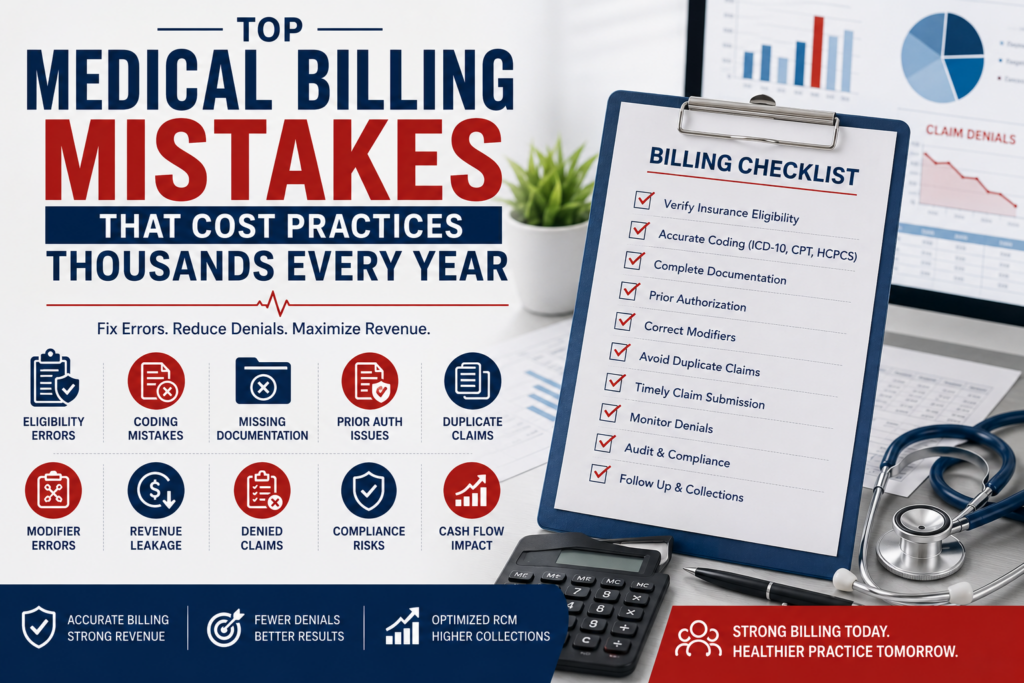
Medical billing is the financial backbone of every healthcare practice. Whether you operate a primary care clinic, specialty practice, behavioral health center, urgent care facility, or multi-provider organization, even small medical billing mistakes can result in delayed reimbursements, denied claims, compliance risks, and significant revenue loss.
According to industry reports, healthcare providers lose thousands—and in some cases millions—of dollars annually due to preventable medical billing errors. Incorrect coding, missing documentation, insurance verification failures, duplicate claims, and billing compliance issues can disrupt cash flow and increase administrative costs.
As healthcare regulations continue to evolve and payer requirements become more complex, practices must prioritize billing accuracy to maintain profitability and reduce revenue leakage. An optimized Revenue Cycle Management (RCM) process supported by experienced billing professionals helps improve clean claim rates, accelerate reimbursements, and strengthen financial performance.
In this guide, we’ll explore the most common medical billing mistakes, explain how they affect your practice’s bottom line, and provide actionable strategies to improve billing compliance, reduce denied claims, and optimize your revenue cycle.
Why Medical Billing Mistakes Hurt Revenue
Every medical claim passes through multiple stages before reimbursement is received. A single mistake anywhere in the billing workflow can trigger claim rejections, payment delays, insurance audits, or complete denial of reimbursement.
Medical billing mistakes not only delay payments but also increase administrative workload. Staff members must investigate denials, correct errors, resubmit claims, communicate with payers, and follow up on outstanding balances. This consumes valuable time that could otherwise be spent improving patient care and operational efficiency.
Common consequences of billing mistakes include:
- Higher claim denial rates
- Slower insurance reimbursements
- Increased Accounts Receivable (AR)
- Revenue leakage
- Compliance risks
- Patient dissatisfaction
- Additional administrative expenses
- Increased audit exposure
- Lower cash flow
- Reduced profitability
Healthcare organizations that implement proactive billing audits, coding reviews, and quality assurance programs consistently experience higher first-pass claim acceptance rates and improved financial performance.
Top 20 Medical Billing Mistakes
Below are the most common medical billing errors that cost healthcare practices thousands of dollars every year. Identifying and correcting these issues is one of the fastest ways to improve collections and reduce revenue leakage.
1. Insurance Eligibility Verification Errors
Insurance eligibility verification is the first step in the revenue cycle. Unfortunately, many practices rush this process or fail to verify patient coverage before appointments.
Eligibility verification mistakes often lead to rejected claims because the patient’s insurance may have changed, coverage may have expired, deductibles may not have been met, or services may require prior authorization.
Common Eligibility Errors
- Inactive insurance policies
- Incorrect member ID numbers
- Wrong payer selection
- Outdated insurance information
- Failure to verify benefits
- Not checking deductible status
- Missing coordination of benefits (COB)
Implementing real-time eligibility verification before every patient visit significantly reduces denied claims and improves reimbursement accuracy.
2. Incorrect Medical Coding
Medical coding errors remain one of the leading causes of claim denials and payment delays. Accurate coding is essential for communicating diagnoses, procedures, and medical necessity to insurance companies.
Even experienced providers can unintentionally submit incorrect CPT®, ICD-10-CM, or HCPCS Level II codes if documentation is incomplete or coding guidelines are misunderstood.
Examples of Coding Mistakes
- Incorrect CPT codes
- Outdated ICD-10 diagnosis codes
- Improper HCPCS coding
- Diagnosis and procedure mismatches
- Coding without sufficient documentation
- Failure to update annual code changes
- Incorrect place of service (POS) codes
Routine coding education, certified medical coders, and regular coding audits help reduce these costly errors while improving billing compliance.
3. Missing or Incomplete Clinical Documentation
Medical billing depends on accurate provider documentation. If the medical record does not support the billed services, insurance companies may reject the claim or request additional documentation.
Incomplete documentation increases audit risk and delays reimbursement because coders cannot accurately assign diagnosis and procedure codes.
Documentation Issues That Cause Denials
- Missing physician signatures
- Incomplete progress notes
- Insufficient medical necessity documentation
- Missing treatment plans
- Incomplete encounter records
- Lack of supporting clinical evidence
- Unsigned electronic health records
Providers should document every patient encounter thoroughly and promptly to ensure accurate coding and successful claim submission.
4. Missing Prior Authorization
Many healthcare services require prior authorization before treatment is provided. Failure to obtain authorization can result in automatic claim denials—even when the service was medically necessary.
Prior authorization requirements vary by payer and frequently change, making it essential for billing teams to stay current with insurance policies.
Common Prior Authorization Mistakes
- Authorization not obtained
- Expired authorization
- Wrong authorization number
- Incorrect procedure authorized
- Authorization obtained after treatment
- Failure to document authorization approval
A standardized prior authorization workflow can dramatically reduce preventable denials and improve reimbursement timelines.
5. Patient Demographic Errors
Incorrect patient information is one of the simplest yet most frequent medical billing mistakes. Even a minor typo in a patient’s name, date of birth, or insurance ID can cause claim rejection.
Front-desk staff play a critical role in collecting and verifying accurate patient information during registration.
Common Demographic Errors
- Misspelled patient names
- Incorrect birth dates
- Wrong insurance ID numbers
- Incorrect addresses
- Outdated phone numbers
- Missing subscriber information
- Incorrect gender designation
Practices should verify demographic information at every patient visit rather than relying on existing records.
6. Filing Claims After Timely Filing Deadlines
Every insurance payer has strict deadlines for claim submission. Missing these deadlines often results in permanent denial with little opportunity for appeal.
Timely filing limits may range from 30 days to one year depending on the payer, making efficient billing workflows essential.
| Common Cause | Impact on Practice |
|---|---|
| Delayed coding | Late claim submission |
| Incomplete documentation | Missed filing deadlines |
| Staff shortages | Claim backlog |
| Workflow inefficiencies | Lost reimbursement opportunities |
Automated claim tracking and regular billing reviews help ensure all claims are submitted within payer deadlines.
7. Incorrect Modifier Usage
Medical billing modifiers provide additional information about procedures performed and help payers determine the appropriate reimbursement. Incorrect, missing, or unnecessary modifiers are among the most common claim denial reasons.
Examples include failing to append modifier 25 for a significant, separately identifiable evaluation and management (E/M) service or incorrectly using modifier 59 when National Correct Coding Initiative (NCCI) edits do not support separate reimbursement.
Modifier Errors Include:
- Missing required modifiers
- Using incorrect modifiers
- Modifier sequencing errors
- Modifier overuse
- Billing without documentation supporting modifier use
Regular coding audits and ongoing staff education help ensure modifiers are used accurately and in accordance with payer guidelines.
8. Duplicate Claim Submission
Submitting the same claim multiple times without verifying its processing status can create unnecessary payment delays and trigger duplicate claim denials. Duplicate submissions also increase administrative workload for both providers and insurance payers.
Before resubmitting a claim, billing staff should verify whether the original claim is still being processed or if additional documentation has been requested.
9. Failure to Follow Up on Denied Claims
Many healthcare practices write off denied claims without investigating the root cause or submitting an appeal. This is one of the most expensive medical billing mistakes because many denials are recoverable when corrected and resubmitted promptly.
Effective denial management is a critical component of Revenue Cycle Management (RCM). Every denied claim should be categorized, analyzed, corrected, and appealed when appropriate.
Common Reasons Claims Are Denied
- Medical necessity not established
- Incorrect diagnosis or procedure code
- Missing documentation
- Eligibility issues
- Prior authorization missing
- Duplicate claim submission
- Timely filing exceeded
- Incorrect patient information
Practices that actively monitor denial trends can significantly reduce future billing errors and improve reimbursement rates.
10. Poor Accounts Receivable (AR) Management
Outstanding Accounts Receivable (AR) directly impact cash flow. Claims that remain unpaid for extended periods become increasingly difficult to collect, leading to avoidable revenue leakage.
Healthcare organizations should regularly monitor aging reports and prioritize follow-up on older outstanding claims.
Best Practices for AR Management
- Review aging reports weekly
- Prioritize claims older than 60 days
- Assign dedicated AR specialists
- Appeal denied claims promptly
- Monitor payer payment trends
11. Billing for Non-Covered Services
Insurance policies differ significantly in terms of covered benefits. Billing for services excluded under a patient’s plan frequently results in claim denials and unnecessary administrative work.
Eligibility verification should include benefit verification, coverage limitations, and payer-specific policies before services are rendered.
12. Inadequate Staff Training
Medical billing regulations, CPT®, ICD-10-CM updates, payer policies, and CMS guidelines change every year. Without ongoing education, billing staff may unknowingly submit incorrect claims that reduce reimbursement.
Investing in continuing education improves billing accuracy, coding compliance, and overall revenue cycle performance.
13. Failure to Perform Routine Billing Audits
Internal billing audits help identify workflow issues before they become expensive problems. Practices that regularly perform medical billing audits often discover recurring coding mistakes, documentation deficiencies, and payer-specific billing issues.
Routine audits improve compliance while strengthening financial performance.
14. Poor Communication Between Clinical and Billing Teams
Clinical documentation drives coding, and coding drives billing. When providers and billing teams fail to communicate effectively, claims often contain incomplete information that leads to reimbursement delays.
Regular communication between physicians, coders, and billing specialists improves documentation quality and claim accuracy.
15. Ignoring Payer Policy Updates
Insurance companies frequently update billing guidelines, reimbursement policies, authorization requirements, and documentation standards.
Practices that fail to stay informed risk submitting non-compliant claims that may be denied or underpaid.
16. Undercoding Services
Many providers focus on avoiding compliance risks but unintentionally undercode services. While undercoding reduces audit exposure, it also results in significant lost revenue over time.
Accurate coding—not overcoding or undercoding—ensures providers receive appropriate reimbursement for medically necessary services.
17. Upcoding Procedures
Upcoding occurs when services are billed at a higher level than documentation supports. This creates serious compliance risks and may trigger payer audits, repayment demands, penalties, or fraud investigations.
Proper documentation and certified coding review help prevent accidental upcoding.
18. Failure to Monitor Key Revenue Cycle Metrics
Successful practices regularly track key performance indicators (KPIs) to evaluate billing efficiency.
| KPI | Target Benchmark |
|---|---|
| Clean Claim Rate | 95% or Higher |
| First Pass Resolution Rate | 90%+ |
| Denial Rate | Less Than 5% |
| Days in Accounts Receivable | Under 40 Days |
| Net Collection Rate | 95%+ |
Monitoring these KPIs helps identify opportunities for RCM optimization and continuous improvement.
19. Not Using Technology and Automation
Manual billing processes increase the likelihood of human error. Modern billing software, automated eligibility verification, claim scrubbing tools, and denial management solutions significantly improve billing efficiency.
Automation also reduces administrative workload while accelerating reimbursement.
20. Trying to Manage Billing In-House Without Specialized Expertise
Many healthcare practices attempt to manage billing internally despite limited staffing, increasing payer complexity, and evolving regulations. This often results in higher denial rates, increased operating costs, and slower collections.
Partnering with an experienced medical billing company allows providers to focus on patient care while specialists manage coding, billing, compliance, denial management, and revenue cycle optimization.
Medical Billing Audit Checklist
Use this simple checklist to identify common billing issues before they impact revenue.
| Audit Item | Status |
|---|---|
| Insurance eligibility verified before every visit | ☐ |
| Accurate CPT, ICD-10, and HCPCS coding | ☐ |
| Documentation supports billed services | ☐ |
| Prior authorizations obtained | ☐ |
| Correct modifiers applied | ☐ |
| Claims submitted within filing deadlines | ☐ |
| Denied claims reviewed and appealed | ☐ |
| Accounts Receivable monitored weekly | ☐ |
| Monthly billing audits completed | ☐ |
| Billing staff receive ongoing education | ☐ |
How to Prevent Costly Medical Billing Mistakes
Reducing billing errors requires a combination of experienced staff, standardized workflows, continuous training, and technology. Practices that invest in proactive quality assurance consistently experience better financial outcomes.
Best Practices
- Perform insurance eligibility verification before every appointment.
- Use certified medical coders.
- Conduct routine coding and billing audits.
- Monitor denial trends monthly.
- Track revenue cycle KPIs.
- Implement claim scrubbing software.
- Stay current with CMS and payer updates.
- Improve provider documentation.
- Train staff regularly.
- Consider outsourcing medical billing to experienced professionals.
Why Healthcare Practices Choose USA MedWorks
USA MedWorks helps healthcare organizations reduce claim denials, improve reimbursement accuracy, and optimize every stage of the revenue cycle.
Our comprehensive services include:
- Medical Billing Services
- Medical Coding Services
- Revenue Cycle Management (RCM)
- Insurance Eligibility Verification
- Prior Authorization Support
- Denial Management
- Accounts Receivable Follow-up
- Payment Posting
- Credentialing Services
- Billing Compliance Audits
Our experienced billing professionals help practices improve collections, reduce administrative burden, and maintain compliance with evolving payer regulations.
Internal Resources
- Medical Billing Services
- Revenue Cycle Management Services
- Medical Billing & Coding Services
- Provider Credentialing Services
- Request a Free Consultation
Helpful External Resources
- Centers for Medicare & Medicaid Services (CMS)
- U.S. Department of Health & Human Services – Office of Inspector General (OIG)
- AAPC
- American Medical Association (AMA)
Frequently Asked Questions
What is the most common medical billing mistake?
Insurance eligibility verification failures, coding errors, missing documentation, and incorrect modifiers are among the most common causes of claim denials.
How do medical billing mistakes affect revenue?
Billing mistakes delay reimbursements, increase denied claims, create revenue leakage, raise administrative costs, and reduce overall cash flow.
What is revenue leakage in healthcare?
Revenue leakage refers to lost income caused by preventable billing errors, denied claims, coding inaccuracies, untimely filing, and inefficient revenue cycle processes.
How often should practices perform medical billing audits?
Healthcare organizations should conduct internal billing audits monthly or quarterly to identify recurring issues, improve compliance, and optimize reimbursement.
Should medical billing be outsourced?
Outsourcing medical billing allows practices to improve collections, reduce claim denials, enhance compliance, lower operating costs, and focus more on patient care.
Conclusion
Even seemingly minor medical billing mistakes can have a significant impact on a healthcare practice’s financial health. From eligibility verification failures and coding errors to missing documentation, duplicate claims, and poor denial management, these issues contribute to revenue leakage, delayed reimbursements, and unnecessary administrative expenses.
By implementing standardized billing workflows, conducting routine audits, monitoring key revenue cycle metrics, and investing in ongoing staff education, practices can improve billing accuracy, strengthen compliance, and maximize reimbursement.
Partnering with an experienced medical billing company like USA MedWorks provides access to industry expertise, advanced technology, and comprehensive revenue cycle management solutions that help practices reduce denials, increase collections, and achieve long-term financial success.
Ready to Eliminate Costly Medical Billing Mistakes?
USA MedWorks helps healthcare providers nationwide improve billing accuracy, reduce denied claims, optimize revenue cycle management, and maximize reimbursements through professional medical billing and coding services.