
The Revenue Cycle Management Workflow is the foundation of every financially successful healthcare organization. From scheduling a patient’s first appointment to collecting the final payment, every step in the revenue cycle management process directly impacts reimbursement, operational efficiency, patient satisfaction, and overall profitability.
Healthcare providers face increasing challenges such as changing payer requirements, evolving CMS regulations, prior authorization complexities, staffing shortages, and rising claim denial rates. Without a streamlined medical billing workflow, these issues can quickly lead to revenue leakage, delayed reimbursements, increased Accounts Receivable (AR), and unnecessary administrative costs.
Whether you’re a physician practice, specialty clinic, behavioral health provider, urgent care center, ambulatory surgery center, or multi-specialty healthcare organization, understanding each stage of the healthcare RCM workflow is essential for maximizing collections and improving financial performance.
In this comprehensive guide, we’ll walk through every stage of the Revenue Cycle Management Workflow, explain why each step matters, and share best practices to optimize your healthcare revenue cycle.
What Is Revenue Cycle Management (RCM)?
Revenue Cycle Management (RCM) is the end-to-end financial process healthcare organizations use to manage patient revenue—from appointment scheduling and insurance verification to claim submission, payment posting, denial management, and patient collections.
The goal of healthcare RCM is simple:
- Improve reimbursement accuracy
- Reduce claim denials
- Increase clean claim rates
- Accelerate insurance payments
- Reduce Accounts Receivable (AR)
- Improve billing compliance
- Strengthen cash flow
- Enhance patient financial experience
An optimized revenue cycle allows providers to spend less time managing administrative tasks and more time delivering quality patient care.
Why the Revenue Cycle Management Workflow Matters
Every stage in the revenue cycle management process depends on the successful completion of the previous step. A single mistake during patient registration, coding, or claim submission can delay reimbursement by weeks or even months.
For example:
- Incorrect insurance information can trigger immediate claim rejection.
- Missing prior authorization may result in non-payment.
- Incomplete documentation leads to coding errors.
- Incorrect CPT or ICD-10 coding increases denial rates.
- Poor denial management delays cash flow.
Practices that optimize each stage of their RCM workflow typically experience:
- Higher clean claim rates
- Lower denial percentages
- Faster reimbursement
- Improved cash flow
- Reduced billing costs
- Higher patient satisfaction
- Improved regulatory compliance
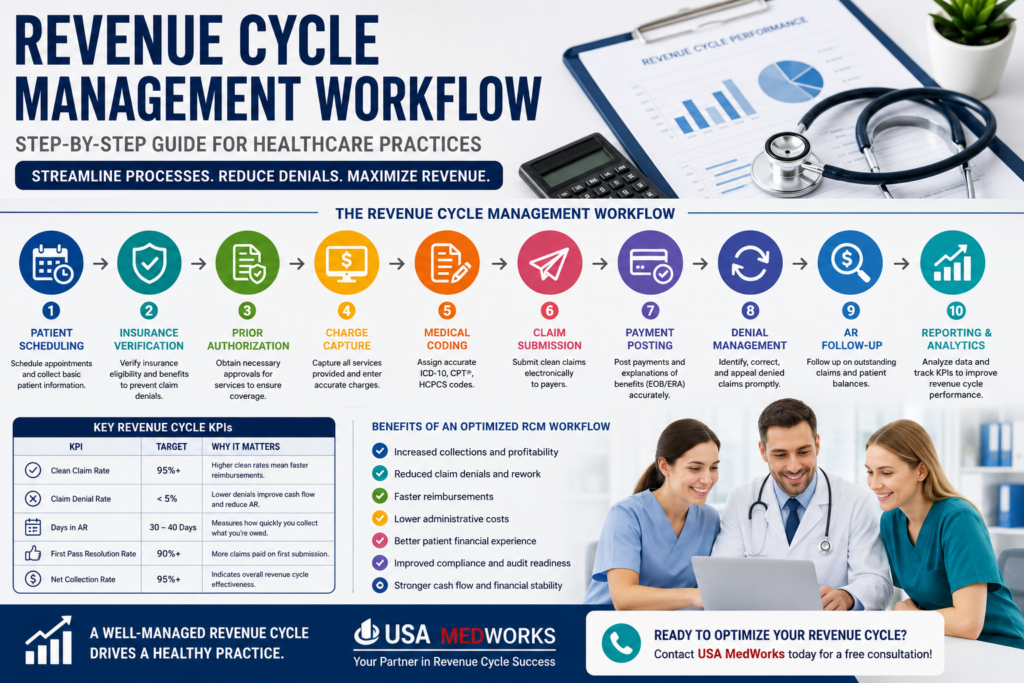
Revenue Cycle Management Workflow Diagram
The following simplified workflow illustrates how healthcare revenue moves from patient scheduling to final payment collection.
| Patient Scheduling | ➡️ | Insurance Verification | ➡️ | Prior Authorization | ➡️ | Charge Capture |
| ⬇️ | ||||||
| Medical Coding | ➡️ | Claim Submission | ➡️ | Payment Posting | ➡️ | Denial Management |
| ⬇️ | ||||||
| Accounts Receivable Follow-up | ➡️ | Patient Collections | ➡️ | Reporting & Analytics | ||
Every step contributes to the overall health of your practice’s financial operations.
Step 1: Patient Scheduling
The revenue cycle begins long before a patient arrives for an appointment. Effective scheduling establishes the foundation for an efficient billing process.
During scheduling, front-office staff collect basic patient demographics, insurance information, referral details, and appointment information.
Scheduling Best Practices
- Verify patient identity.
- Collect current insurance information.
- Confirm referring provider when required.
- Educate patients about financial responsibility.
- Schedule appointments according to payer requirements.
- Capture updated contact information.
Accurate scheduling reduces registration errors and improves downstream billing accuracy.
Step 2: Insurance Verification
Insurance verification is one of the most important steps in the medical billing workflow. Before services are rendered, healthcare organizations should verify patient eligibility, active coverage, deductible status, copayments, coinsurance, and benefit limitations.
Failing to verify insurance coverage is one of the leading causes of denied claims and delayed reimbursement.
Insurance Verification Checklist
- Confirm active coverage.
- Verify policy effective dates.
- Check deductible status.
- Review copayment requirements.
- Identify referral requirements.
- Determine prior authorization needs.
- Confirm payer-specific billing rules.
Automated eligibility verification tools significantly reduce administrative workload while improving reimbursement accuracy.
Step 3: Prior Authorization
Many healthcare services require prior authorization before treatment can be provided. This step confirms that the payer has approved the service based on medical necessity and coverage guidelines.
Failure to obtain prior authorization can result in automatic claim denial—even when services were medically appropriate.
Services That Often Require Authorization
- Advanced imaging
- Surgical procedures
- Specialty medications
- Behavioral health services
- Physical therapy
- Durable medical equipment (DME)
- Certain outpatient procedures
Successful authorization management improves reimbursement while minimizing avoidable denials.
Step 4: Charge Capture
Charge capture ensures that every billable service performed during a patient encounter is accurately documented and entered into the billing system.
Missed or inaccurate charges directly contribute to revenue leakage and underpayment.
Charge Capture Includes
- Office visits
- Diagnostic testing
- Procedures
- Laboratory services
- Immunizations
- Medical supplies
- Telehealth encounters
Accurate charge capture improves reimbursement while ensuring providers receive payment for all medically necessary services.
Step 5: Medical Coding
After services are documented, certified medical coders translate clinical documentation into standardized coding systems including CPT®, ICD-10-CM, and HCPCS Level II codes.
Medical coding serves as the foundation of every insurance claim. Coding accuracy directly affects reimbursement, compliance, audit readiness, and denial rates.
| Code Type | Purpose |
|---|---|
| CPT® | Reports medical procedures and physician services. |
| ICD-10-CM | Identifies patient diagnoses and medical necessity. |
| HCPCS Level II | Reports supplies, medications, DME, and non-physician services. |
Benefits of Accurate Coding
- Higher clean claim rates
- Lower denial rates
- Improved billing compliance
- Accurate reimbursement
- Reduced audit risk
- Faster claim processing
- Better financial reporting
Healthcare organizations should perform regular coding audits and provide ongoing education to ensure compliance with annual coding updates and payer requirements.
Continue to Part 2 to learn about claim submission, payment posting, denial management, Accounts Receivable (AR) follow-up, reporting and analytics, key revenue cycle KPIs, optimization strategies, internal resources, FAQ Schema, and how USA MedWorks helps healthcare organizations maximize reimbursement through comprehensive Revenue Cycle Management services.
Step 6: Claim Submission
After coding has been completed and quality checks are performed, claims are electronically submitted to Medicare, Medicaid, and commercial insurance carriers. This stage is one of the most critical parts of the Revenue Cycle Management Workflow because even minor claim errors can result in rejections or denials.
Most healthcare organizations utilize electronic claim submission through a clearinghouse, which validates claims before forwarding them to the appropriate payer. Claim scrubbing technology identifies missing information, coding inconsistencies, modifier issues, and formatting errors before submission.
Claim Submission Best Practices
- Verify patient demographics before submission.
- Ensure CPT®, ICD-10-CM, and HCPCS codes are accurate.
- Apply required modifiers.
- Confirm provider credentials.
- Review payer-specific billing guidelines.
- Use claim scrubbing software.
- Submit claims within timely filing limits.
A high-performing healthcare RCM process typically achieves a clean claim rate of more than 95%, significantly reducing delays in reimbursement.
Step 7: Payment Posting
Once insurance companies process claims, payments are received electronically through Electronic Remittance Advice (ERA) or paper Explanation of Benefits (EOB). Payment posting records every reimbursement, contractual adjustment, deductible, copayment, coinsurance, and remaining patient balance.
Accurate payment posting ensures financial reports remain reliable while allowing billing teams to quickly identify underpayments or unpaid claims.
Payment Posting Includes
- Insurance payments
- Patient payments
- Contractual adjustments
- Coinsurance
- Deductibles
- Write-offs
- Secondary insurance payments
Timely payment posting provides complete visibility into practice revenue and improves overall revenue cycle performance.
Step 8: Denial Management
Even highly efficient billing departments experience claim denials. The difference between successful and struggling healthcare organizations lies in how quickly denied claims are identified, corrected, and appealed.
Effective denial management focuses on identifying the root causes of denials, correcting billing errors, educating staff, and preventing similar issues in the future.
Common Claim Denial Reasons
- Insurance eligibility issues
- Missing prior authorization
- Coding inaccuracies
- Incorrect modifiers
- Incomplete documentation
- Duplicate claims
- Medical necessity denials
- Timely filing exceeded
Practices should monitor denial trends monthly and implement corrective actions to improve first-pass claim acceptance.
Step 9: Accounts Receivable (AR) Follow-up
Accounts Receivable (AR) management ensures unpaid claims receive timely follow-up until payment is collected or the claim is resolved.
Outstanding claims represent delayed revenue. Without consistent follow-up, healthcare organizations risk losing reimbursement due to timely filing limits, payer inactivity, or administrative oversight.
Effective AR Follow-up Strategies
- Review aging reports weekly.
- Prioritize claims over 30, 60, and 90 days.
- Contact insurance companies promptly.
- Appeal denied claims quickly.
- Monitor payer response times.
- Collect outstanding patient balances.
- Track collection performance.
Reducing Days in Accounts Receivable improves cash flow while strengthening overall financial stability.
Step 10: Reporting & Analytics
The final stage of the Revenue Cycle Management Workflow focuses on measuring financial performance through detailed reporting and analytics.
Revenue cycle reports help healthcare leaders identify workflow bottlenecks, monitor reimbursement trends, improve operational efficiency, and make data-driven business decisions.
Essential Revenue Cycle Reports
- Clean claim rate
- Denial rate analysis
- Accounts Receivable aging
- Collection reports
- Payment trends
- Provider productivity
- Payer performance analysis
- Revenue forecasting
Organizations that regularly review financial reports are better equipped to improve billing efficiency and maximize reimbursement.
Key Revenue Cycle Management KPIs
Tracking Key Performance Indicators (KPIs) allows healthcare practices to evaluate the effectiveness of their medical billing workflow and identify opportunities for improvement.
| KPI | Industry Benchmark | Why It Matters |
|---|---|---|
| Clean Claim Rate | 95%+ | Measures claims accepted on first submission. |
| Claim Denial Rate | <5% | Indicates billing and coding accuracy. |
| Days in Accounts Receivable | 30–40 Days | Measures collection efficiency. |
| Net Collection Rate | 95%+ | Shows actual revenue collected. |
| First Pass Resolution Rate | 90%+ | Tracks claims paid without resubmission. |
| Patient Collection Rate | 90%+ | Measures patient payment success. |
Benefits of an Optimized Revenue Cycle Management Workflow
A streamlined revenue cycle management process improves every aspect of a healthcare organization’s financial operations.
- Higher clean claim rates
- Fewer denied claims
- Improved coding accuracy
- Faster reimbursement
- Lower administrative costs
- Reduced Accounts Receivable
- Improved compliance with CMS guidelines
- Better patient financial experience
- Greater profitability
- Scalable healthcare operations
How USA MedWorks Optimizes Healthcare Revenue Cycle Management
USA MedWorks partners with physician practices, specialty clinics, behavioral health providers, urgent care centers, and healthcare organizations nationwide to streamline every phase of the revenue cycle.
Our experienced professionals combine advanced billing technology with proven revenue cycle strategies to improve collections, reduce claim denials, and maximize reimbursement.
Our Revenue Cycle Management Services Include
- Insurance Eligibility Verification
- Patient Registration Support
- Prior Authorization Services
- Medical Coding Services
- Medical Billing Services
- Electronic Claim Submission
- Payment Posting
- Denial Management & Appeals
- Accounts Receivable Follow-up
- Credentialing & Provider Enrollment
- Financial Reporting & Analytics
Internal Resources
- Revenue Cycle Management Services
- Medical Billing Services
- Medical Billing & Coding Services
- Provider Credentialing Services
- Request a Free Consultation
Helpful External Resources
- Centers for Medicare & Medicaid Services (CMS)
- AAPC
- American Medical Association (AMA)
- Medical Group Management Association (MGMA)
Frequently Asked Questions
What is the Revenue Cycle Management Workflow?
The Revenue Cycle Management Workflow is the complete financial process healthcare providers use to manage patient revenue, beginning with appointment scheduling and ending with payment collection and financial reporting.
Why is insurance verification important in healthcare RCM?
Insurance verification confirms active coverage, benefits, deductibles, copayments, and authorization requirements before services are provided, reducing claim denials and reimbursement delays.
What is denial management?
Denial management is the process of identifying, correcting, appealing, and preventing denied insurance claims to improve reimbursement and reduce revenue leakage.
How does Accounts Receivable affect cash flow?
Outstanding Accounts Receivable represent unpaid claims. Effective AR follow-up accelerates collections, improves cash flow, and reduces lost revenue.
Should healthcare practices outsource Revenue Cycle Management?
Many practices outsource Revenue Cycle Management to improve billing accuracy, reduce administrative costs, increase collections, and gain access to experienced billing professionals and advanced RCM technology.
Conclusion
The Revenue Cycle Management Workflow is much more than a billing process—it is a comprehensive financial strategy that supports the long-term success of healthcare organizations. Every stage, from patient scheduling and insurance verification to claim submission, denial management, Accounts Receivable follow-up, and reporting, plays a critical role in maximizing reimbursement and maintaining healthy cash flow.
Healthcare providers that invest in efficient medical billing workflows, accurate coding, proactive denial management, and ongoing performance monitoring consistently achieve higher clean claim rates, lower denial percentages, faster reimbursements, and improved patient satisfaction.
Partnering with an experienced RCM company like USA MedWorks enables practices to streamline operations, remain compliant with evolving regulations, reduce administrative burden, and focus on delivering exceptional patient care while experts manage the complexities of healthcare revenue cycle management.
Ready to Optimize Your Revenue Cycle?
Whether you’re looking to reduce claim denials, improve collections, strengthen compliance, or outsource your entire revenue cycle, USA MedWorks provides customized Revenue Cycle Management solutions designed to maximize financial performance.