
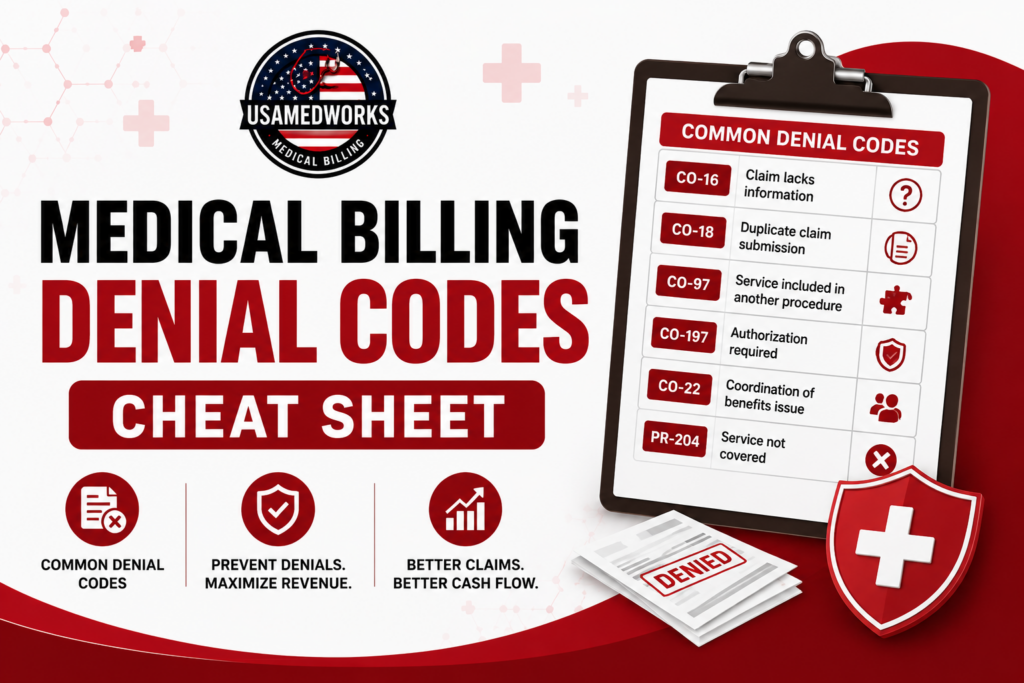
Medical billing claim denials are one of the biggest revenue challenges healthcare providers face today. Denied claims can delay reimbursements, increase administrative workload, and negatively impact cash flow.
This medical billing denial codes cheat sheet helps healthcare providers, medical practices, billing teams, and revenue cycle management (RCM) professionals understand the most common insurance denial codes, prevent claim rejections, and improve reimbursement rates.
Whether you manage a private practice, urgent care clinic, behavioral health center, or specialty healthcare organization, understanding denial management strategies is essential for maintaining financial stability and maximizing collections.
Download Denial Codes Cheat Sheet PDF
What Are Medical Billing Denial Codes?
Medical billing denial codes are standardized insurance codes used by payers to explain why a healthcare claim was denied, reduced, or rejected.
Understanding denial codes helps medical billing teams identify root causes, correct claim issues, and resubmit claims faster.
Most Common Medical Billing Denial Codes
| Denial Code | Description | Common Cause |
|---|---|---|
| CO-16 | Claim lacks information | Missing patient or billing data |
| CO-18 | Duplicate claim submission | Claim submitted multiple times |
| CO-97 | Service included in another procedure | Bundling or modifier issue |
| CO-197 | Authorization required | Missing prior authorization |
| CO-22 | Coordination of benefits issue | Incorrect payer sequence |
| PR-204 | Service not covered | Non-covered insurance benefit |
Common Reasons for Claim Denials
- Incorrect CPT or ICD-10 coding
- Missing patient eligibility verification
- Authorization errors
- Duplicate claim submissions
- Modifier misuse
- Incomplete medical documentation
- Timely filing limit violations
Top CPT Codes Frequently Associated with Denials
| CPT Code | Description |
|---|---|
| 99213 | Established patient office visit |
| 99214 | Moderate complexity office visit |
| 90834 | Psychotherapy, 45 minutes |
| 93000 | Electrocardiogram |
| 36415 | Routine venipuncture |
ICD-10 Examples Commonly Reviewed by Insurance Payers
- E11.9 – Type 2 diabetes mellitus without complications
- I10 – Essential hypertension
- F41.1 – Generalized anxiety disorder
- M54.5 – Low back pain
- J06.9 – Acute upper respiratory infection
Payer-Specific Denial Management Tips
Medicare
- Ensure medical necessity documentation is complete.
- Verify modifier usage for bundled services.
- Monitor NCCI edits regularly.
Medicaid
- Confirm patient eligibility before every visit.
- Watch for state-specific authorization requirements.
Commercial Insurance Payers
- Verify timely filing limits.
- Review payer-specific modifier policies.
- Check telehealth billing requirements.
How to Reduce Medical Billing Denials
Reducing claim denials starts with proactive revenue cycle management strategies. Healthcare providers can improve clean claim rates by:
- Performing insurance eligibility verification
- Using accurate CPT and ICD-10 coding
- Submitting claims quickly
- Tracking denial trends
- Conducting regular coding audits
- Improving provider documentation
Benefits of Professional Denial Management Services
Professional denial management services help healthcare organizations:
- Reduce accounts receivable (AR)
- Improve reimbursement turnaround
- Recover lost revenue
- Increase clean claim rates
- Improve cash flow stability
- Enhance billing compliance
Internal Resources
- Medical Billing Services
- Revenue Cycle Management Services
- Mental Health Billing Services
- Provider Credentialing Services
Helpful External Resources
- Centers for Medicare & Medicaid Services (CMS)
- American Medical Association (AMA)
- AAPC Medical Coding Resources
Frequently Asked Questions
What is the most common medical billing denial code?
CO-16 and CO-18 are among the most common denial codes in healthcare billing.
How can healthcare providers reduce denied claims?
Providers can reduce denials through accurate coding, eligibility verification, authorization management, and proactive denial tracking.
What is denial management in medical billing?
Denial management is the process of identifying, correcting, appealing, and preventing insurance claim denials.
Conclusion
Medical billing denial codes directly impact healthcare revenue cycle performance and reimbursement outcomes. Understanding common denial reasons and implementing proactive denial management strategies can help healthcare organizations reduce claim rejections, improve collections, and strengthen financial performance.
USA MedWorks provides professional medical billing, coding, denial management, and RCM services designed to help healthcare providers maximize reimbursements and reduce administrative burdens.
Need Help Reducing Medical Billing Denials?
Contact USA MedWorks today to improve your claim acceptance rates, streamline billing operations, and optimize your healthcare revenue cycle management.