
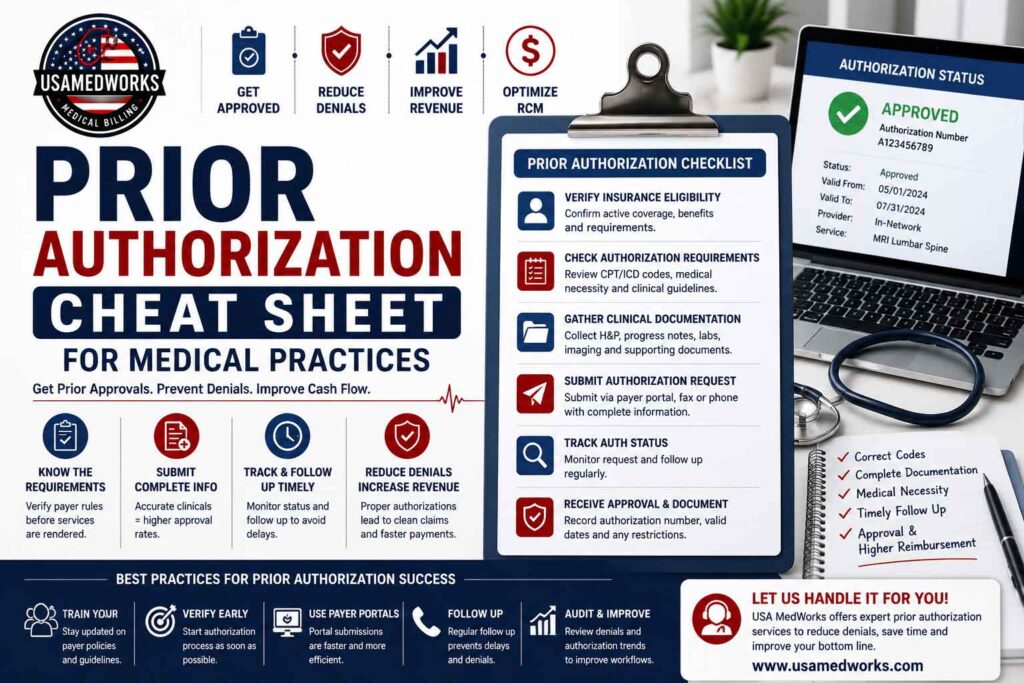
Prior authorization is one of the most challenging and time-consuming aspects of healthcare revenue cycle management. Healthcare providers across specialties frequently encounter delays, claim denials, and administrative burdens due to payer-specific authorization requirements.
This comprehensive prior authorization cheat sheet helps physicians, practice managers, medical billers, and healthcare administrators understand authorization workflows, improve claim approval rates, reduce denials, and optimize medical billing operations.
What Is Prior Authorization?
Prior authorization (PA), sometimes called pre-authorization, pre-certification, or pre-approval, is a utilization management process used by insurance companies to determine whether a specific medical service, procedure, medication, or treatment is medically necessary before it is performed.
Insurance carriers use prior authorization programs to control healthcare costs and ensure appropriate utilization of services.
Why Prior Authorization Matters in Medical Billing
Failure to obtain authorization when required can result in claim denials, delayed reimbursements, and lost revenue.
- Reduces claim denials
- Improves reimbursement rates
- Supports compliance requirements
- Improves patient financial transparency
- Strengthens healthcare revenue cycle management
Most Common Services Requiring Prior Authorization
| Service Category | Examples |
|---|---|
| Advanced Imaging | MRI, CT Scans, PET Scans |
| Specialty Medications | Biologics, Infusions |
| Surgical Procedures | Orthopedic, Bariatric, Spine Surgery |
| Behavioral Health | Intensive Therapy Programs |
| Durable Medical Equipment | CPAP, Wheelchairs, Braces |
Prior Authorization Workflow Checklist
- Verify insurance eligibility.
- Confirm authorization requirements.
- Gather clinical documentation.
- Submit authorization request.
- Track authorization status.
- Receive approval or denial.
- Document authorization number.
- Submit clean claim.
Common Prior Authorization Denial Reasons
- Authorization not obtained.
- Authorization expired.
- Incorrect CPT code submitted.
- Insufficient medical necessity documentation.
- Service not covered by payer.
- Incomplete authorization request.
- Provider out of network.
Top CPT Codes Frequently Requiring Prior Authorization
| CPT Code | Description |
|---|---|
| 70553 | MRI Brain with and without contrast |
| 73721 | MRI Lower Extremity |
| 27130 | Total Hip Arthroplasty |
| 27447 | Total Knee Arthroplasty |
| 99215 | High Complexity E/M Visit |
ICD-10 Examples Commonly Reviewed During Authorization
- M54.5 – Low Back Pain
- M25.561 – Knee Pain
- G43.909 – Migraine
- F41.1 – Generalized Anxiety Disorder
- E11.9 – Type 2 Diabetes Mellitus
Payer-Specific Prior Authorization Tips
Medicare Advantage Plans
- Verify plan-specific requirements.
- Review annual policy updates.
- Document medical necessity thoroughly.
UnitedHealthcare
- Use online authorization portals.
- Check CPT-specific authorization lists regularly.
Aetna
- Confirm specialty-specific requirements.
- Submit complete clinical records.
Blue Cross Blue Shield
- Authorization policies vary by state.
- Review local plan guidelines.
Best Practices to Reduce Authorization Denials
- Verify requirements before scheduling.
- Train staff on payer policies.
- Use authorization tracking software.
- Maintain complete documentation.
- Submit requests early.
- Conduct regular workflow audits.
How Prior Authorization Affects Revenue Cycle Management
Authorization delays can significantly impact healthcare cash flow. Effective authorization management reduces denied claims, improves reimbursement timelines, and strengthens overall revenue cycle performance.
Benefits of Outsourcing Prior Authorization Services
- Reduced administrative burden
- Improved approval rates
- Faster turnaround times
- Lower denial rates
- Increased staff productivity
- Enhanced patient satisfaction
Internal Resources
- Medical Billing Services
- Revenue Cycle Management Services
- Provider Credentialing Services
- Medical Billing & Coding Services
- Mental Health Billing Services
Helpful External Resources
- Centers for Medicare & Medicaid Services (CMS)
- American Medical Association (AMA)
- AAPC Coding Resources
Frequently Asked Questions
What is prior authorization in medical billing?
Prior authorization is a payer approval process that confirms medical necessity before a service is performed.
Why are prior authorization requests denied?
Common reasons include missing documentation, lack of medical necessity, incorrect CPT codes, and incomplete submissions.
How can providers reduce prior authorization denials?
Healthcare providers can reduce denials through proactive verification, complete documentation, and payer-specific workflow management.
Conclusion
Prior authorization remains a critical component of healthcare revenue cycle management. Understanding payer requirements, maintaining proper documentation, and implementing efficient authorization workflows can significantly reduce denials and improve reimbursement performance.
USA MedWorks helps healthcare providers streamline prior authorization management, reduce claim denials, and maximize revenue through expert medical billing and RCM services.
Need Help Managing Prior Authorizations?
Contact USA MedWorks today to improve authorization approval rates, reduce billing delays, and optimize your healthcare revenue cycle.