
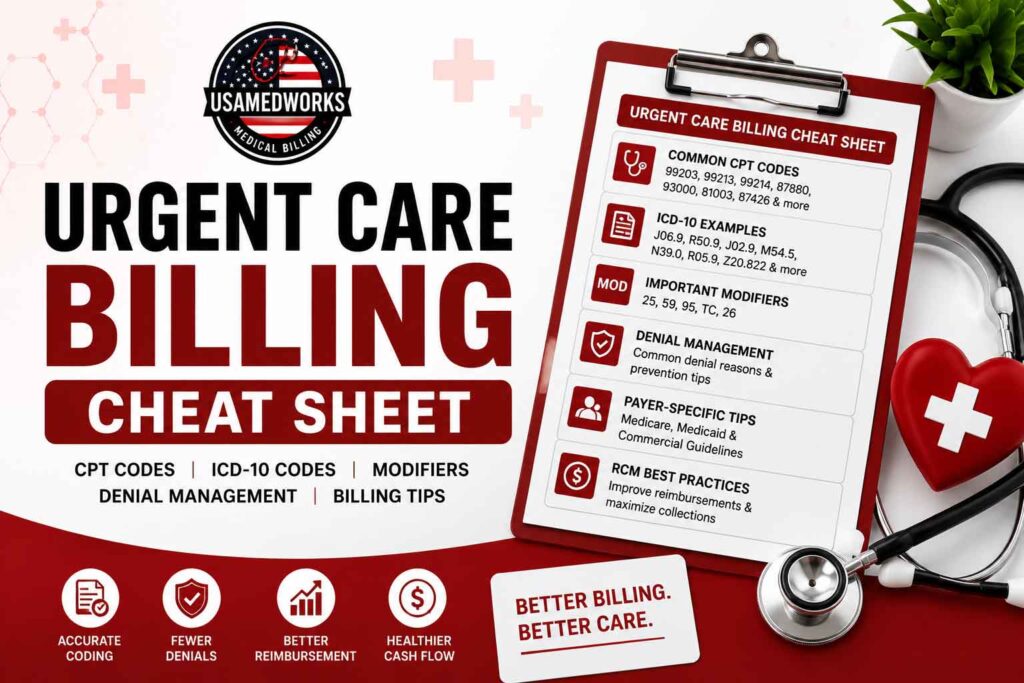
Urgent care billing is one of the most challenging areas of healthcare revenue cycle management due to high patient volumes, same-day services, insurance verification complexities, and evolving payer requirements.
Healthcare providers operating urgent care clinics must accurately manage CPT coding, ICD-10 diagnosis selection, medical billing modifiers, prior authorization requirements, and denial management processes to maximize reimbursements and maintain healthy cash flow.
This comprehensive urgent care billing cheat sheet helps urgent care providers, medical billers, coders, and healthcare administrators improve claim accuracy, reduce insurance denials, and optimize revenue cycle management (RCM).
What Is Urgent Care Billing?
Urgent care billing refers to the process of coding, submitting, tracking, and collecting payments for urgent care medical services. Since urgent care centers treat a wide range of acute illnesses and injuries, billing workflows often involve multiple CPT codes, diagnostic procedures, lab tests, imaging services, and evaluation and management (E/M) visits.
Efficient urgent care medical billing is essential for:
- Reducing claim denials
- Improving reimbursement rates
- Increasing clean claim submissions
- Maintaining HIPAA compliance
- Optimizing healthcare revenue cycle management
Most Common Urgent Care CPT Codes
| CPT Code | Description |
|---|---|
| 99203 | New patient office visit |
| 99204 | Moderate complexity urgent care visit |
| 99213 | Established patient office visit |
| 99214 | Moderate complexity established patient visit |
| 87880 | Rapid strep test |
| 87426 | COVID-19 antigen test |
| 81003 | Urinalysis |
| 93000 | Electrocardiogram |
Common ICD-10 Codes Used in Urgent Care Billing
- J06.9 – Acute upper respiratory infection
- R50.9 – Fever unspecified
- J02.9 – Acute pharyngitis
- M54.5 – Low back pain
- S93.401A – Sprain of unspecified ankle
- R05.9 – Cough unspecified
- N39.0 – Urinary tract infection
- Z20.822 – Exposure to COVID-19
Important Urgent Care Billing Modifiers
| Modifier | Description |
|---|---|
| 25 | Significant separately identifiable E/M service |
| 59 | Distinct procedural service |
| 95 | Telehealth service modifier |
| TC | Technical component |
| 26 | Professional component |
Common Urgent Care Claim Denial Reasons
Urgent care claims are frequently denied due to coding errors, documentation issues, and payer-specific requirements.
The most common urgent care billing denial reasons include:
- Missing modifier 25
- Duplicate claim submission
- Incorrect ICD-10 diagnosis code
- Insurance eligibility verification failure
- Authorization not obtained
- Medical necessity issues
- Timely filing limit exceeded
- Incorrect provider credentialing information
Urgent Care Revenue Cycle Management Best Practices
Effective urgent care revenue cycle management improves collections and reduces administrative burdens.
Best practices include:
- Verifying insurance eligibility before patient visits
- Submitting clean claims quickly
- Conducting coding audits regularly
- Tracking denial trends
- Using certified medical coders
- Monitoring payer reimbursement updates
- Implementing proactive accounts receivable follow-up
Payer-Specific Urgent Care Billing Tips
Medicare
- Ensure medical necessity documentation supports services billed.
- Use correct POS codes for urgent care encounters.
- Verify NCCI edits before claim submission.
Medicaid
- Check patient eligibility during every visit.
- Follow state-specific billing guidelines.
- Monitor authorization requirements carefully.
Commercial Insurance
- Review payer-specific modifier policies.
- Confirm timely filing deadlines.
- Validate telehealth billing rules.
How Outsourced Urgent Care Billing Services Help
Many urgent care clinics outsource medical billing services to improve operational efficiency and reduce claim denials.
Professional urgent care billing companies help providers:
- Improve clean claim rates
- Accelerate reimbursements
- Reduce billing errors
- Increase cash flow
- Manage denial appeals
- Optimize coding accuracy
Benefits of Professional Medical Billing and Coding Services
Experienced medical billing and coding teams provide:
- Certified coding expertise
- HIPAA-compliant billing workflows
- Accurate CPT and ICD-10 coding
- Detailed financial reporting
- Improved healthcare reimbursement rates
- Reduced administrative overhead
Internal Resources
- Medical Billing Services
- Revenue Cycle Management Services
- Provider Credentialing Services
- Medical Billing and Coding Services
- Mental Health Billing Services
Helpful External Resources
- Centers for Medicare & Medicaid Services (CMS)
- AAPC Medical Coding Resources
- American Medical Association (AMA)
Frequently Asked Questions
What are the most common urgent care CPT codes?
99203, 99213, 99214, 87880, and 93000 are among the most commonly used urgent care CPT codes.
Why are urgent care claims denied?
Urgent care claims are commonly denied due to modifier errors, missing documentation, eligibility issues, and incorrect coding.
How can urgent care clinics reduce claim denials?
Urgent care clinics can reduce denials through accurate coding, insurance verification, proper documentation, and proactive denial management.
What is modifier 25 in urgent care billing?
Modifier 25 indicates that a separately identifiable E/M service was performed on the same day as another procedure.
Conclusion
Urgent care billing requires accurate medical coding, effective denial management, and optimized revenue cycle management processes to maintain financial stability and maximize healthcare reimbursements.
Using an urgent care billing cheat sheet helps healthcare providers improve coding accuracy, reduce billing errors, and strengthen overall medical billing performance.
USA MedWorks provides professional urgent care billing services, medical coding support, denial management solutions, and complete healthcare revenue cycle management services for healthcare providers nationwide.
Need Expert Urgent Care Billing Services?
Contact USA MedWorks today to improve claim acceptance rates, reduce denials, and optimize your urgent care revenue cycle management strategy.