
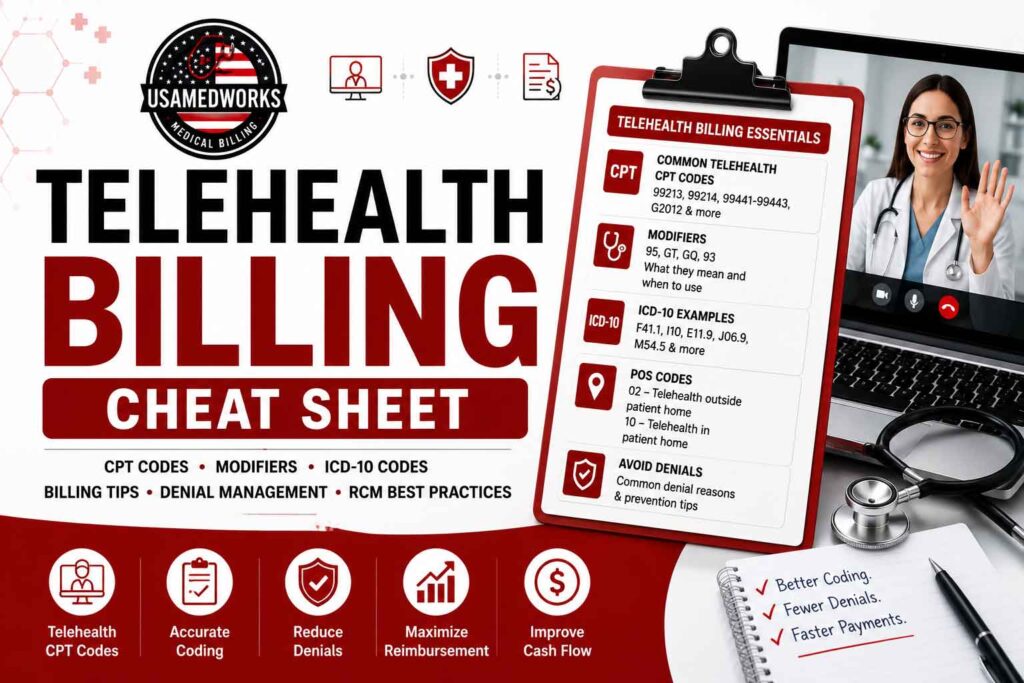
Telehealth billing has become a critical component of modern healthcare revenue cycle management (RCM). As virtual healthcare services continue to grow, healthcare providers must understand telemedicine billing guidelines, CPT coding requirements, ICD-10 diagnosis coding, telehealth modifiers, payer-specific billing rules, and denial management strategies.
This comprehensive telehealth billing cheat sheet helps healthcare providers, medical billing teams, telemedicine practices, urgent care centers, behavioral health clinics, and healthcare administrators improve coding accuracy, reduce claim denials, and maximize telehealth reimbursements.
Understanding telehealth medical billing requirements is essential for maintaining compliance and optimizing financial performance in today’s digital healthcare environment.
What Is Telehealth Billing?
Telehealth billing is the process of coding and submitting insurance claims for healthcare services delivered remotely through audio, video, or digital communication technologies.
Telemedicine billing involves:
- Telehealth CPT coding
- ICD-10 diagnosis coding
- Telehealth modifiers
- POS (Place of Service) coding
- Insurance eligibility verification
- Denial management
- Revenue cycle management optimization
Accurate telehealth billing ensures healthcare providers receive proper reimbursement for virtual patient care services.
Why Telehealth Billing Is Important
As more patients prefer remote healthcare access, telehealth services have become a permanent part of healthcare delivery. However, telemedicine reimbursement policies vary between Medicare, Medicaid, and commercial insurance payers.
Incorrect telehealth coding or modifier usage can result in:
- Claim denials
- Payment delays
- Reduced reimbursements
- Compliance risks
- Billing audits
Using a telehealth billing cheat sheet helps providers improve claim accuracy and reduce administrative errors.
Most Common Telehealth CPT Codes
| CPT Code | Description |
|---|---|
| 99213 | Established patient office visit via telehealth |
| 99214 | Moderate complexity telehealth office visit |
| 99441 | Telephone E/M service 5-10 minutes |
| 99442 | Telephone E/M service 11-20 minutes |
| 99443 | Telephone E/M service 21-30 minutes |
| G2012 | Virtual check-in service |
| 99421 | Online digital E/M service |
| 90834 | Telehealth psychotherapy session |
Important Telehealth Billing Modifiers
| Modifier | Description |
|---|---|
| 95 | Synchronous telemedicine service |
| GT | Interactive audio and video telecommunication |
| GQ | Store-and-forward telecommunication |
| 93 | Audio-only telemedicine services |
Place of Service (POS) Codes for Telehealth
| POS Code | Description |
|---|---|
| 02 | Telehealth provided outside patient home |
| 10 | Telehealth provided in patient home |
Using the correct POS code is essential for proper telehealth claim reimbursement.
Common ICD-10 Codes Used in Telehealth Billing
- F41.1 – Generalized anxiety disorder
- F32.9 – Major depressive disorder
- I10 – Essential hypertension
- E11.9 – Type 2 diabetes mellitus
- J06.9 – Acute upper respiratory infection
- M54.5 – Low back pain
- Z71.89 – Counseling and coordination of care
Common Telehealth Billing Denial Reasons
Telehealth claims are often denied due to coding errors, missing modifiers, or payer policy violations.
The most common telehealth billing denial reasons include:
- Missing modifier 95
- Incorrect POS code
- Patient ineligible for telehealth coverage
- Unsupported CPT code
- Incomplete documentation
- Duplicate claim submission
- Authorization issues
- Incorrect provider credentialing information
Telehealth Revenue Cycle Management Best Practices
Optimizing telehealth revenue cycle management helps healthcare organizations improve cash flow and reduce denied claims.
Best practices include:
- Verifying insurance coverage before telehealth visits
- Using accurate telehealth CPT codes
- Applying correct telehealth modifiers
- Monitoring payer telemedicine policies
- Maintaining detailed clinical documentation
- Conducting regular coding audits
- Tracking denial trends
Payer-Specific Telehealth Billing Tips
Medicare Telehealth Billing
- Medicare requires accurate POS coding.
- Use modifier 95 when appropriate.
- Confirm eligible telehealth services regularly.
Medicaid Telehealth Billing
- Telehealth policies vary by state.
- Check state-specific reimbursement guidelines.
- Verify audio-only service coverage.
Commercial Insurance Telehealth Billing
- Commercial payer telehealth policies differ significantly.
- Review modifier requirements carefully.
- Confirm prior authorization rules.
Behavioral Health Telehealth Billing
Behavioral health and mental health telemedicine services have experienced significant growth. Psychiatry and therapy telehealth billing require accurate psychotherapy CPT coding and payer-specific modifier usage.
Common behavioral health telehealth CPT codes include:
- 90791 – Psychiatric diagnostic evaluation
- 90832 – Psychotherapy 30 minutes
- 90834 – Psychotherapy 45 minutes
- 90837 – Psychotherapy 60 minutes
Benefits of Outsourced Telehealth Billing Services
Outsourcing telehealth medical billing services helps healthcare providers improve billing efficiency and maximize reimbursements.
Professional telehealth billing companies provide:
- Accurate coding support
- HIPAA-compliant workflows
- Denial management services
- Insurance follow-up
- Credentialing assistance
- Revenue cycle optimization
Internal Resources
- Medical Billing Services
- Revenue Cycle Management Services
- Mental Health Billing Services
- Medical Billing and Coding Services
- Provider Credentialing Services
Helpful External Resources
- Centers for Medicare & Medicaid Services (CMS)
- AAPC Medical Coding Resources
- HHS Telehealth Resources
- American Medical Association (AMA)
Frequently Asked Questions
What modifier is used for telehealth billing?
Modifier 95 is the most commonly used telehealth billing modifier for synchronous virtual healthcare services.
What are the most common telehealth CPT codes?
99213, 99214, 99441, 99442, G2012, and 90834 are among the most commonly billed telehealth CPT codes.
Why are telehealth claims denied?
Telehealth claims are commonly denied due to missing modifiers, incorrect POS codes, unsupported services, or documentation errors.
How can providers improve telehealth reimbursements?
Healthcare providers can improve telehealth reimbursements through accurate coding, insurance verification, payer compliance, and proactive denial management.
Conclusion
Telehealth billing requires accurate CPT coding, ICD-10 diagnosis selection, telehealth modifier usage, and payer-specific compliance management to maximize reimbursements and reduce claim denials.
Using a telehealth billing cheat sheet helps healthcare organizations improve billing accuracy, optimize revenue cycle management, and strengthen financial performance.
USA MedWorks provides professional telehealth billing services, medical coding support, denial management solutions, and healthcare revenue cycle management services for healthcare providers nationwide.
Need Expert Telehealth Billing Services?
Contact USA MedWorks today to improve telehealth claim acceptance rates, reduce billing errors, and optimize your telemedicine revenue cycle management strategy.