Medical Billing Compliance Checklist: A Complete Guide for Healthcare Practices
Medical billing compliance is no longer just a regulatory requirement it is an essential part of maintaining a financially healthy healthcare practice. Every healthcare provider, from independent physicians to multi-specialty groups and behavioral health clinics, must ensure their billing processes comply with federal regulations, payer requirements, and industry coding standards.
Failure to maintain proper compliance can result in claim denials, delayed reimbursements, payer audits, financial penalties, False Claims Act investigations, and reputational damage.
A well-designed Medical Billing Compliance Checklist helps healthcare organizations improve coding accuracy, strengthen documentation, reduce billing errors, maintain HIPAA compliance, and optimize Revenue Cycle Management (RCM).
This comprehensive guide explains the most important compliance requirements every healthcare organization should follow, including HIPAA regulations, coding compliance, documentation standards, CMS requirements, and best practices for audit readiness.
What Is Medical Billing Compliance?
Medical billing compliance refers to following all federal regulations, payer policies, documentation standards, and coding guidelines when submitting healthcare claims.
The objective is to ensure that every medical claim is:
- Accurately coded
- Supported by complete documentation
- Medically necessary
- HIPAA compliant
- Submitted according to CMS and payer guidelines
- Protected against fraud, waste, and abuse
Compliance protects both healthcare providers and patients while supporting accurate reimbursement and ethical billing practices.
Why Medical Billing Compliance Matters
Healthcare reimbursement regulations continue to evolve. Medicare, Medicaid, and commercial insurance companies regularly update coding rules, reimbursement policies, and documentation requirements.
Maintaining compliance helps healthcare organizations:
- Reduce claim denials
- Improve reimbursement accuracy
- Prevent billing fraud allegations
- Reduce audit risk
- Protect patient information
- Improve coding accuracy
- Strengthen Revenue Cycle Management
- Increase clean claim rates
- Maintain payer relationships
- Protect practice revenue
Organizations with strong compliance programs generally experience fewer payment delays and lower administrative costs.
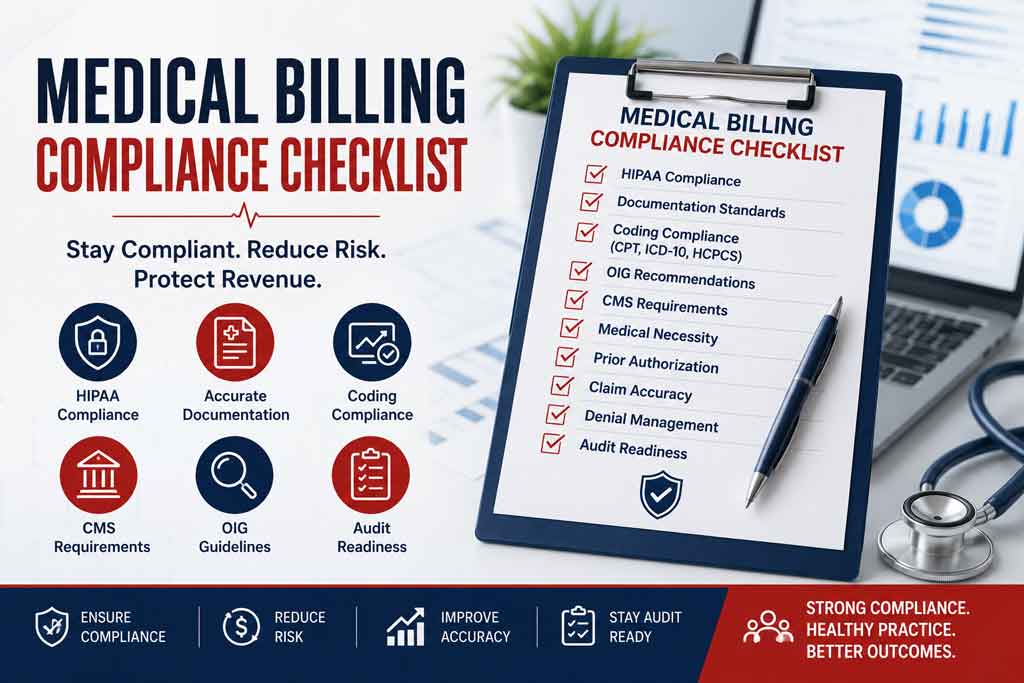
Medical Billing Compliance Checklist
Every healthcare organization should regularly review the following compliance areas.
| Compliance Area | Purpose |
|---|---|
| HIPAA Compliance | Protect patient information |
| Insurance Eligibility Verification | Prevent claim denials |
| Provider Credentialing | Ensure billing eligibility |
| Medical Documentation | Support medical necessity |
| CPT Coding Accuracy | Correct procedure reporting |
| ICD-10 Coding | Accurate diagnosis reporting |
| Modifier Usage | Prevent coding errors |
| Prior Authorization | Avoid authorization denials |
| Claim Submission | Meet payer requirements |
| Denial Management | Recover revenue |
| Internal Audits | Identify compliance gaps |
Following this checklist consistently helps reduce billing errors while improving revenue cycle performance.
HIPAA Compliance in Medical Billing
The Health Insurance Portability and Accountability Act (HIPAA) establishes national standards for protecting patient health information.
Medical billing staff handle protected health information (PHI) daily, making HIPAA compliance one of the most important responsibilities within the revenue cycle.
HIPAA Compliance Checklist
- Protect electronic Protected Health Information (ePHI).
- Use secure billing software.
- Limit employee access to PHI.
- Encrypt electronic communications.
- Maintain secure passwords.
- Provide annual HIPAA training.
- Conduct regular security risk assessments.
- Maintain Business Associate Agreements (BAAs).
- Report data breaches promptly.
- Maintain HIPAA documentation policies.
HIPAA violations can lead to significant financial penalties and legal consequences, making ongoing compliance essential for every healthcare organization.
Medical Documentation Requirements
Accurate documentation is the foundation of compliant medical billing. Every CPT code submitted must be fully supported by provider documentation.
Medical documentation should clearly demonstrate:
- Medical necessity
- Chief complaint
- History of present illness
- Clinical findings
- Assessment
- Treatment plan
- Orders
- Provider signature
- Date of service
Incomplete documentation frequently results in claim denials, coding errors, and failed payer audits.
Coding Compliance: CPT, ICD-10, and HCPCS
Accurate coding is one of the most critical aspects of medical billing compliance. Coding errors can lead to claim denials, reimbursement delays, payer audits, and compliance investigations.
CPT Coding Compliance
Current Procedural Terminology (CPT) codes must accurately represent the services performed.
Healthcare providers should avoid:
- Upcoding
- Undercoding
- Duplicate billing
- Unbundling procedures
- Incorrect modifier usage
ICD-10 Compliance
Diagnosis codes should accurately reflect the patient’s condition while supporting medical necessity.
Best practices include:
- Select the highest level of specificity.
- Use current ICD-10 code sets.
- Avoid unspecified diagnoses whenever possible.
- Ensure diagnosis supports billed procedures.
HCPCS Compliance
HCPCS Level II codes are commonly used for supplies, medications, ambulance services, and durable medical equipment.
Billing teams should verify that HCPCS codes comply with payer-specific reimbursement requirements.
Common Medical Billing Compliance Mistakes
Even experienced healthcare organizations can unintentionally create compliance risks through inconsistent billing practices.
The most common compliance mistakes include:
- Billing services not documented.
- Using outdated CPT codes.
- Incorrect ICD-10 diagnosis selection.
- Missing prior authorizations.
- Improper modifier usage.
- Failure to verify insurance eligibility.
- Late claim submission.
- Incomplete provider documentation.
- Credentialing issues.
- Failure to perform internal billing audits.
Identifying and correcting these issues early helps practices reduce financial risk and maintain regulatory compliance.
Medical Billing Compliance Best Practices
Healthcare organizations can strengthen compliance by implementing standardized operational procedures across every stage of the revenue cycle.
- Conduct quarterly medical billing audits.
- Train coding and billing staff regularly.
- Review payer policy updates monthly.
- Use certified professional coders.
- Monitor denial trends.
- Verify insurance eligibility before appointments.
- Perform documentation audits.
- Implement claim scrubbing software.
- Track compliance KPIs.
- Maintain written compliance policies.
Organizations that prioritize continuous compliance improvement generally experience higher clean claim rates, fewer payer audits, and stronger financial performance.
Warning Signs Your Practice May Have Compliance Risks
The following indicators may suggest weaknesses in your medical billing compliance program:
- Increasing claim denial rates.
- Frequent payer audits.
- Recurring coding errors.
- High number of documentation deficiencies.
- Growing accounts receivable balances.
- Repeated prior authorization denials.
- HIPAA security incidents.
- Provider credentialing delays.
- Patient complaints regarding billing.
- Declining reimbursement rates.
If your organization experiences one or more of these warning signs, conducting a comprehensive medical billing compliance review can help identify gaps and reduce future risk.