
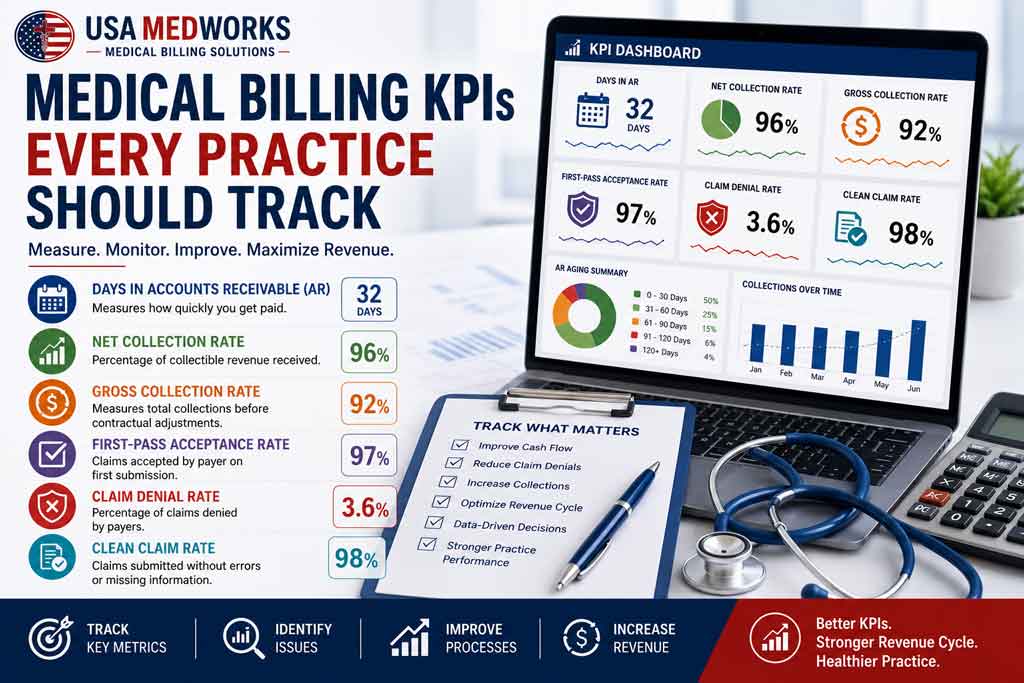
Medical Billing KPIs Every Practice Should Track
Healthcare organizations generate thousands of financial transactions every month, but without tracking the right Medical Billing KPIs (Key Performance Indicators), it is difficult to understand whether the revenue cycle is operating efficiently.
Many practices focus solely on monthly collections, yet collections represent only one part of a much larger healthcare revenue cycle management (RCM) process. High-performing healthcare organizations continuously monitor medical billing KPIs to identify bottlenecks, reduce claim denials, improve coding accuracy, shorten reimbursement cycles, and maximize profitability.
Whether you manage a physician practice, urgent care center, behavioral health clinic, multispecialty group, or ambulatory surgery center, monitoring the right billing metrics enables you to make informed financial decisions while improving operational performance.
This comprehensive guide explains the most important medical billing KPIs every healthcare practice should track, industry benchmark values, and practical strategies for improving each metric.
What Are Medical Billing KPIs?
Medical Billing KPIs (Key Performance Indicators) are measurable financial and operational metrics used to evaluate the performance of healthcare revenue cycle management.
These indicators help healthcare providers measure billing efficiency, monitor insurance reimbursements, identify operational weaknesses, reduce claim denials, improve collections, and strengthen overall financial performance.
Medical Billing KPIs allow administrators to answer important questions such as:
- How quickly are insurance companies paying claims?
- How many claims are denied each month?
- Are coding errors reducing reimbursements?
- How effective is the billing team?
- Is cash flow improving?
- Which insurance payers are causing payment delays?
- Are accounts receivable increasing?
- Is the practice collecting all earned revenue?
Without reliable KPI reporting, healthcare organizations often make decisions based on assumptions instead of measurable performance data.
Why Medical Billing KPIs Matter
Healthcare reimbursement has become increasingly complex. Insurance companies regularly update reimbursement policies, coding requirements, documentation standards, and prior authorization rules.
Tracking medical billing KPIs helps providers:
- Improve cash flow
- Reduce claim denials
- Increase clean claim rates
- Improve first-pass acceptance rates
- Reduce Accounts Receivable (AR)
- Increase reimbursement accuracy
- Improve coding compliance
- Strengthen healthcare revenue cycle management
- Identify staff training opportunities
- Improve patient satisfaction
Organizations that regularly monitor KPIs generally experience fewer billing errors, lower denial rates, and stronger long-term financial performance.
Medical Billing KPI Dashboard Overview
A healthcare KPI dashboard provides leadership with real-time visibility into revenue cycle performance.
Every practice should monitor the following core KPIs:
| KPI | Purpose |
|---|---|
| Days in Accounts Receivable | Measures payment speed |
| Net Collection Rate | Measures actual revenue collected |
| Gross Collection Rate | Measures total collections |
| First-Pass Acceptance Rate | Measures claim accuracy |
| Denial Rate | Measures billing effectiveness |
| Clean Claim Rate | Measures claim quality |
| Charge Lag | Measures billing efficiency |
| Bad Debt Rate | Measures collection performance |
Monitoring these KPIs consistently helps healthcare organizations identify opportunities for revenue improvement before financial problems become significant.
KPI #1 – Days in Accounts Receivable (Days in AR)
Days in Accounts Receivable is one of the most important medical billing KPIs because it measures how quickly healthcare providers receive payment after submitting claims.
A lower Days in AR indicates a healthier revenue cycle.
Formula
Days in AR = Total Accounts Receivable ÷ Average Daily Charges
Industry Benchmark
| Performance Level | Days in AR |
|---|---|
| Excellent | Under 30 Days |
| Good | 30–40 Days |
| Needs Improvement | Over 50 Days |
How to Improve Days in AR
- Verify insurance eligibility before every visit.
- Submit clean claims within 24–48 hours.
- Follow up on unpaid claims every 30 days.
- Reduce claim denials.
- Improve payment posting accuracy.
- Strengthen denial management.
Practices that maintain lower AR days typically experience stronger cash flow and healthier financial performance.
KPI #2 – Net Collection Rate (NCR)
The Net Collection Rate measures how much collectible revenue the practice actually receives after contractual adjustments.
This KPI reflects the overall effectiveness of the medical billing process.
Formula
Net Collection Rate = Payments Received ÷ Adjusted Charges × 100
Industry Benchmark
| Performance | Net Collection Rate |
|---|---|
| Excellent | 98%+ |
| Good | 95–97% |
| Poor | Below 94% |
A declining Net Collection Rate often indicates hidden revenue leakage caused by claim denials, underpayments, billing errors, or ineffective follow-up.
Ways to Improve Net Collection Rate
- Reduce claim denials.
- Improve coding accuracy.
- Monitor payer underpayments.
- Strengthen insurance follow-up.
- Appeal denied claims promptly.
- Improve patient collections.
KPI #3 – Gross Collection Rate (GCR)
The Gross Collection Rate measures the percentage of total charges collected before contractual adjustments are considered.
Although Net Collection Rate is generally more meaningful, Gross Collection Rate still provides valuable insight into overall collection performance.
Formula
Gross Collection Rate = Total Payments ÷ Total Charges × 100
Industry Benchmark
| Performance | Gross Collection Rate |
|---|---|
| Excellent | 90%+ |
| Average | 80–89% |
| Below Average | Under 80% |
Healthcare administrators should evaluate Gross Collection Rate alongside Net Collection Rate for a complete understanding of practice financial performance.
Best Practices for Improving Medical Billing KPIs
Improving healthcare revenue cycle performance requires continuous monitoring and process improvement.
- Verify insurance eligibility before appointments.
- Obtain prior authorizations early.
- Improve provider documentation.
- Use certified medical coders.
- Implement claim scrubbing software.
- Track KPI dashboards monthly.
- Conduct routine medical billing audits.
- Monitor payer reimbursement trends.
- Train billing staff regularly.
- Review denial reports weekly.
Organizations that actively monitor these KPIs typically experience improved reimbursement rates, lower denial percentages, and stronger financial stability.
Common Warning Signs That KPIs Need Attention
If your practice experiences any of the following issues, it may be time to conduct a comprehensive revenue cycle assessment:
- Increasing Days in Accounts Receivable.
- Declining Net Collection Rate.
- Frequent insurance denials.
- Growing outstanding AR balances.
- Increasing patient complaints about billing.
- Lower monthly collections.
- Higher coding error rates.
- Delayed payment posting.
- Frequent payer audits.
- Reduced provider profitability.
Recognizing these warning signs early allows healthcare organizations to implement corrective actions before revenue loss becomes significant.
KPI #4 – First-Pass Acceptance Rate (FPAR)
The First-Pass Acceptance Rate (FPAR) measures the percentage of claims accepted by insurance payers on the first submission without requiring corrections, edits, or resubmission. It is one of the most valuable Medical Billing KPIs because it directly impacts reimbursement speed, staff productivity, and cash flow.
Formula
First-Pass Acceptance Rate = (Claims Accepted on First Submission ÷ Total Claims Submitted) × 100
Industry Benchmark
| Performance | Acceptance Rate |
|---|---|
| Excellent | 98%+ |
| Good | 95–97% |
| Needs Improvement | Below 95% |
How to Improve First-Pass Acceptance
- Verify insurance eligibility before appointments.
- Submit claims within 48 hours.
- Review CPT and ICD-10 coding accuracy.
- Use automated claim scrubbing software.
- Ensure prior authorizations are obtained.
- Monitor payer-specific claim edits.
KPI #5 – Claim Denial Rate
The Claim Denial Rate measures the percentage of claims denied by insurance companies after submission. High denial rates indicate problems with coding, documentation, insurance verification, or billing workflows.
Formula
Denial Rate = (Denied Claims ÷ Total Submitted Claims) × 100
Industry Benchmark
| Performance | Denial Rate |
|---|---|
| Excellent | Below 3% |
| Good | 3–5% |
| Poor | Above 5% |
Common Reasons for Claim Denials
- Insurance eligibility issues
- Missing prior authorization
- Incorrect CPT codes
- Invalid ICD-10 diagnosis codes
- Documentation deficiencies
- Duplicate claims
- Modifier errors
- Timely filing limits exceeded
Reducing claim denials significantly improves reimbursement speed and decreases administrative costs.
KPI #6 – Clean Claim Rate
The Clean Claim Rate measures the percentage of claims submitted without errors that can be processed and paid without additional intervention. High clean claim rates are essential for maximizing revenue and minimizing delays.
Industry Benchmark
| Performance | Clean Claim Rate |
|---|---|
| Excellent | 98%+ |
| Good | 95–97% |
| Needs Improvement | Below 95% |
Best Practices for Increasing Clean Claim Rates
- Verify patient demographics.
- Confirm insurance eligibility.
- Review coding accuracy.
- Validate modifiers.
- Use claim scrubbing software.
- Conduct monthly billing audits.
Additional Medical Billing KPIs Every Practice Should Monitor
| KPI | Why It Matters |
|---|---|
| Charge Lag | Measures time from service to claim submission. |
| Bad Debt Rate | Tracks unrecoverable patient balances. |
| Patient Collection Rate | Measures patient payment performance. |
| Average Reimbursement Time | Monitors payer efficiency. |
| Appeal Success Rate | Evaluates denial management effectiveness. |
| Underpayment Recovery Rate | Measures recovered payer underpayments. |
Together, these KPIs provide a complete view of billing performance and help healthcare organizations identify opportunities to improve revenue cycle efficiency.
Building a Medical Billing KPI Dashboard
A centralized KPI dashboard allows practice administrators and billing managers to monitor financial performance in real time.
Your dashboard should include:
- Days in AR
- Net Collection Rate
- Gross Collection Rate
- First-Pass Acceptance Rate
- Claim Denial Rate
- Clean Claim Rate
- Monthly Collections
- Outstanding Insurance AR
- Patient AR
- Payer Performance Reports
Reviewing these metrics monthly helps identify trends and supports data-driven decisions that improve revenue cycle management.
How Outsourcing Medical Billing Improves KPI Performance
Professional medical billing companies use advanced technology, experienced billing specialists, and standardized workflows to improve key performance indicators across the revenue cycle.
Benefits of outsourcing include:
- Higher clean claim rates.
- Lower denial rates.
- Improved Net Collection Rate.
- Reduced Days in AR.
- Faster reimbursement cycles.
- Dedicated denial management.
- Comprehensive KPI reporting.
- Compliance monitoring.
- Revenue cycle consulting.
- Reduced administrative burden.
Healthcare providers partnering with experienced RCM companies often achieve stronger financial performance while allowing clinical teams to focus on patient care.
Internal Resources
- Medical Billing Services
- Revenue Cycle Management Services
- Medical Billing & Coding Services
- Provider Credentialing Services
- Denial Management Services
- Request a Free Consultation
Helpful External Resources
- Centers for Medicare & Medicaid Services (CMS)
- AAPC Medical Coding Resources
- American Medical Association (AMA)
- Medical Group Management Association (MGMA)
Frequently Asked Questions
What are Medical Billing KPIs?
Medical Billing KPIs are measurable performance metrics used to evaluate the efficiency and financial health of a healthcare organization’s revenue cycle management process.
Which KPI is most important?
There is no single KPI that tells the whole story, but Days in AR, Net Collection Rate, First-Pass Acceptance Rate, Denial Rate, and Clean Claim Rate are among the most important indicators of billing performance.
How often should KPIs be reviewed?
Most healthcare organizations review KPI dashboards monthly, while larger practices may monitor key metrics weekly.
How can practices improve Medical Billing KPIs?
Practices can improve KPIs by strengthening insurance eligibility verification, improving coding accuracy, submitting clean claims, reducing denials, automating workflows, and conducting regular billing audits.
Conclusion
Tracking the right Medical Billing KPIs gives healthcare providers the visibility needed to improve financial performance and optimize every stage of the revenue cycle. Metrics such as Days in Accounts Receivable, Net Collection Rate, Gross Collection Rate, First-Pass Acceptance Rate, Denial Rate, and Clean Claim Rate provide valuable insights into billing efficiency, payer performance, and reimbursement success.
Healthcare organizations that consistently monitor these KPIs are better positioned to reduce claim denials, accelerate reimbursements, improve cash flow, strengthen compliance, and increase profitability.
USA MedWorks helps healthcare providers nationwide monitor critical revenue cycle metrics through comprehensive medical billing, coding, denial management, AR follow-up, credentialing, and Revenue Cycle Management (RCM) services.
Ready to Improve Your Medical Billing KPIs?
Partner with USA MedWorks to gain greater visibility into your revenue cycle, reduce billing inefficiencies, improve reimbursement performance, and maximize practice profitability.