
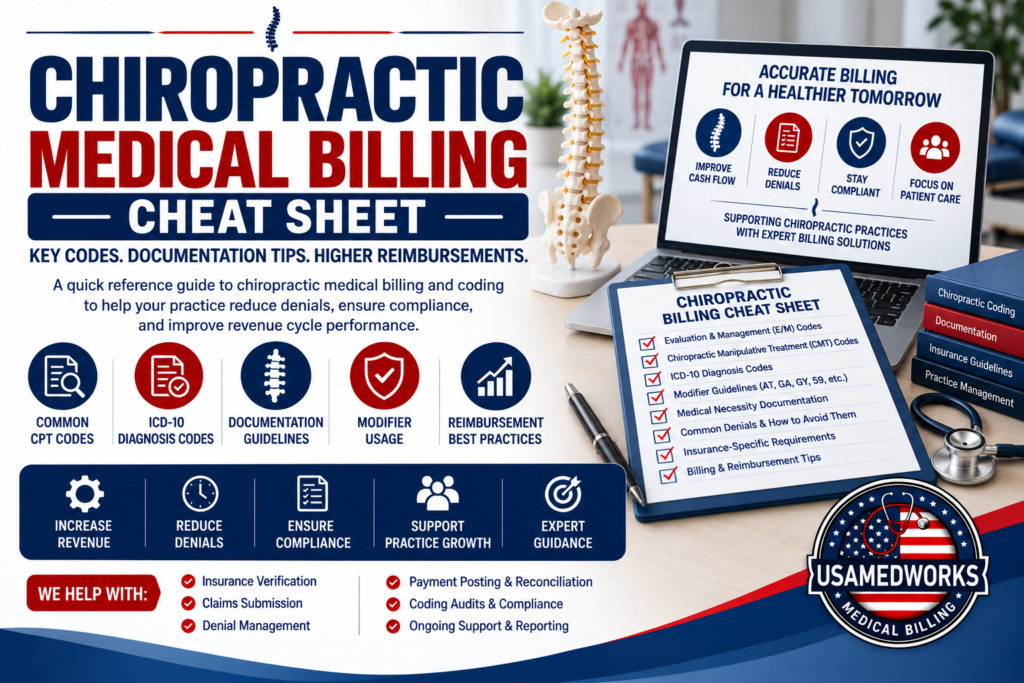
Chiropractic billing has one rule that trips up more practices than any other: Medicare pays only for active, corrective spinal manipulation, never maintenance care, and the AT modifier is what tells the payer which one is being billed. This cheat sheet covers the CPT codes, the AT modifier rule, documentation requirements, and the denial reasons chiropractic claims run into most.
Key Takeaways
- Medicare covers chiropractic manipulative treatment only when it is actively correcting a documented subluxation, and only when modifier AT is appended to show active treatment rather than maintenance care.
- CMT codes are chosen by how many spinal regions are treated, not by the technique used.
- Documentation needs to show the PART findings, pain or tenderness, asymmetry, range of motion, and tissue tone, that support a subluxation diagnosis at each visit, not just at the initial exam.
- Most commercial plans cap chiropractic visits somewhere between 12 and 30 per year, and claims submitted past that cap without an Advance Beneficiary Notice or equivalent waiver are typically denied outright.
Common Chiropractic CPT Codes
| CPT Code | Description |
|---|---|
| 98940 | Chiropractic manipulative treatment, spinal, 1-2 regions |
| 98941 | Chiropractic manipulative treatment, spinal, 3-4 regions |
| 98942 | Chiropractic manipulative treatment, spinal, 5 regions |
| 98943 | Chiropractic manipulative treatment, extraspinal, 1 or more regions |
| 97110 | Therapeutic exercise |
| 97140 | Manual therapy techniques |
| 97112 | Neuromuscular reeducation |
| 99202-99215 | Office or outpatient E/M visit, new or established patient |
The AT Modifier, and Why Medicare Denies Claims Without It
Medicare distinguishes between active or corrective treatment and maintenance care for chiropractic claims, and only active treatment is covered. Modifier AT tells the payer that a claim is for active treatment of a documented subluxation. Without it, or when the documentation doesn’t support ongoing active correction, Medicare denies the claim as maintenance care, which it does not cover regardless of medical necessity language elsewhere in the note. Many commercial plans apply a similar distinction, so the same documentation discipline pays off outside Medicare too.
Documentation That Supports a Subluxation Diagnosis
- PART findings at each visit: pain or tenderness, asymmetry, restricted range of motion, and abnormal tissue tone.
- A treatment plan with measurable functional goals, not just a diagnosis code.
- Re-evaluation at reasonable intervals showing the patient’s response to care, since ongoing treatment without documented improvement or a revised plan is a common audit trigger.
- A clear record of which spinal regions were treated at each visit, matching the CMT code billed.
Visit Limits and Frequency
Visit caps vary by plan, but many commercial and Medicare Advantage plans limit chiropractic care to somewhere between 12 and 30 visits per calendar year. Some plans allow additional visits with documented medical necessity and prior authorization, while others cut off coverage entirely once the cap is reached. An Advance Beneficiary Notice, or the plan’s equivalent waiver, protects the practice’s ability to bill the patient directly once a known limit is exceeded.
Denial Reasons That Show Up Most Often
- Missing AT modifier on a claim for active treatment.
- Subluxation documentation that doesn’t include current PART findings.
- Visits billed past the plan’s annual cap without an ABN or equivalent waiver on file.
- An E/M visit billed the same day as a CMT code without modifier 25 and a separately documented complaint.
- A CMT code billed for more spinal regions than the documentation supports.
When to Outsource Chiropractic Billing
Chiropractic practices that bill in-house often lose more revenue to missing modifiers and visit-cap denials than to the codes themselves, since the rules above apply on nearly every claim rather than occasionally. A billing partner that tracks AT modifier compliance, payer-specific visit limits, and PART documentation standards across many chiropractic accounts typically catches these issues before submission rather than after denial. See our chiropractic billing services page for more detail.
Frequently Asked Questions
What does the AT modifier mean on a chiropractic claim?
The AT modifier tells Medicare and other payers that a chiropractic manipulative treatment claim is for active or corrective treatment of a documented subluxation, rather than maintenance care, which Medicare does not cover.
How many spinal regions does CPT 98940 cover?
CPT 98940 covers chiropractic manipulative treatment of 1 to 2 spinal regions. Three to four regions is billed as 98941, and five regions as 98942.
How many chiropractic visits does insurance typically cover per year?
Coverage varies by plan, but many commercial and Medicare Advantage plans set an annual cap somewhere between 12 and 30 visits. Confirming the specific plan’s limit before treatment begins helps avoid billing past the cap without a waiver on file.
Can a chiropractor bill an office visit and an adjustment on the same day?
Yes, but only with modifier 25 on the E/M code and documentation showing the office visit addressed a separately identifiable complaint beyond the adjustment itself. Without both, the E/M line is typically denied as bundled into the CMT code.