
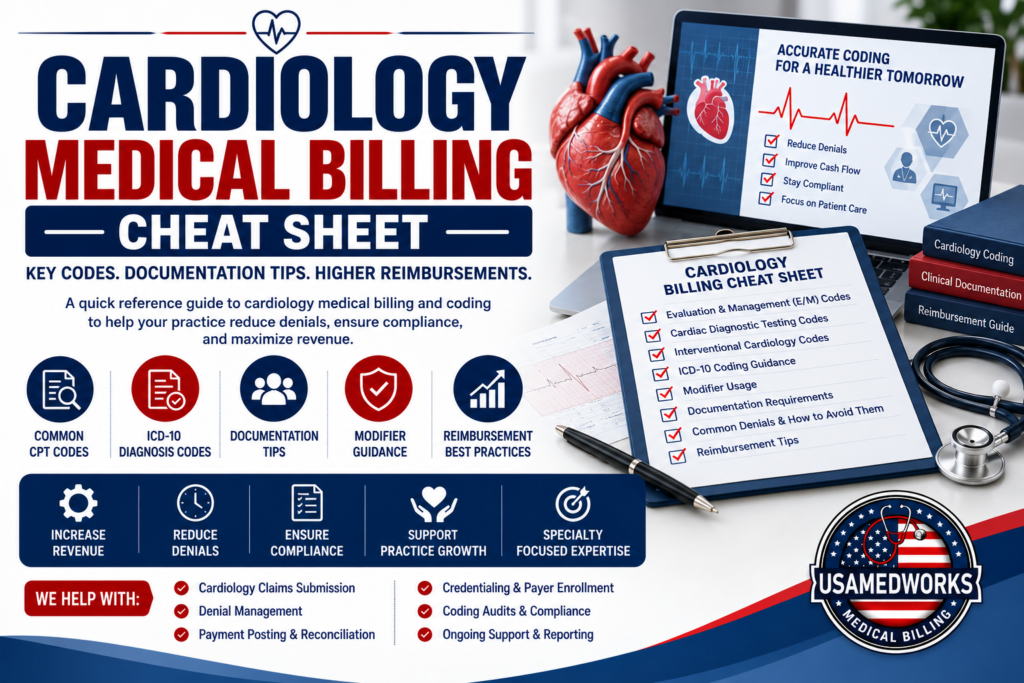
Cardiology billing carries more procedure codes, more modifier rules, and more prior authorization checkpoints than most specialties, because a single visit can combine an office evaluation, a diagnostic test, and an interventional procedure. This cheat sheet lists the CPT and ICD-10 codes cardiology practices use most often, the modifiers that get claims paid correctly the first time, and the denial triggers billing teams run into most.
Key Takeaways
- Cardiology claims frequently combine an E/M visit with a diagnostic test or procedure on the same day, which is the single biggest source of bundling denials when modifier 25 is missing.
- Diagnostic tests like echocardiograms and stress tests split into a professional component and a technical component, billed with modifiers 26 and TC when the interpreting physician and the equipment owner are different entities.
- Cardiac catheterization, nuclear stress testing, and several imaging codes commonly require prior authorization from commercial and Medicare Advantage payers, even when traditional Medicare does not require it.
- Medical necessity documentation, not just an accurate code, is what most cardiology denials come down to.
Common Cardiology CPT Codes
| CPT Code | Description |
|---|---|
| 93000 | Electrocardiogram (ECG), complete, with interpretation and report |
| 93010 | ECG interpretation and report only |
| 93306 | Echocardiogram, complete, with spectral and color Doppler |
| 93017 | Cardiovascular stress test, tracing only |
| 93458 | Left heart catheterization with coronary angiography |
| 93451 | Right heart catheterization |
| 92928 | Percutaneous coronary intervention, single major vessel, stent placement |
| 93224 | External ECG monitoring, up to 48 hours, with interpretation |
ICD-10 Codes Frequently Paired with Cardiology Claims
| ICD-10 Code | Condition |
|---|---|
| I50.9 | Heart failure, unspecified |
| I25.10 | Atherosclerotic heart disease without angina pectoris |
| I11.0 | Hypertensive heart disease with heart failure |
| I48.91 | Unspecified atrial fibrillation |
| I20.9 | Angina pectoris, unspecified |
| R07.9 | Chest pain, unspecified |
Modifiers That Matter in Cardiology Billing
- Modifier 26: professional component only, used when the interpreting cardiologist doesn’t own the equipment, common in hospital-based echocardiograms and stress tests.
- Modifier TC: technical component only, used by the facility or practice that owns the equipment and staff running the test.
- Modifier 25: a significant, separately identifiable E/M service on the same day as a procedure. Missing this modifier is the most common reason a same-day office visit gets denied as bundled into the procedure.
- Modifier 59: distinct procedural service, used when two procedures on the same day would otherwise be bundled under National Correct Coding Initiative edits.
- LT / RT: left or right side, required on several catheterization and vascular procedure codes.
Prior Authorization Triggers
Most Medicare Advantage and commercial plans require prior authorization for cardiac catheterization (93451, 93458), nuclear stress tests, and elective device implants, even in cases where traditional Medicare does not. Confirm authorization status by payer before scheduling these procedures rather than after the claim is submitted, since a missing authorization is one of the few cardiology denials that generally cannot be appealed after the fact.
Denial Reasons That Show Up Most Often
- Same-day E/M and procedure billed without modifier 25, and without documentation showing the E/M was a separately identifiable service.
- Professional and technical components billed together, without a 26/TC split, when the physician and the equipment owner are different entities.
- Stress test or echocardiogram billed more often than the payer’s frequency limit for the diagnosis on file, typically once every 6 to 12 months depending on the plan.
- Missing or expired prior authorization on catheterization and imaging procedures.
- Diagnosis code doesn’t support medical necessity for the test ordered, a frequent issue when a screening-type ICD-10 code is used for a diagnostic procedure.
When to Bring in a Cardiology Billing Specialist
Cardiology denial rates tend to run higher than primary care because of the code volume and prior authorization load described above. Practices seeing denial rates climb past 10 to 15 percent of submitted claims, or spending more staff time chasing authorizations than filing claims, are typically better served outsourcing cardiology billing to a team that tracks payer-specific authorization and frequency rules across a full book of business rather than one practice at a time. Learn more on our cardiology billing services page.
Frequently Asked Questions
What CPT code is used for a complete echocardiogram?
CPT 93306 covers a complete transthoracic echocardiogram with spectral and color Doppler. If the interpreting physician doesn’t own the equipment, the claim splits into modifier 26 for the professional component and modifier TC for the technical component.
Does Medicare require prior authorization for cardiac catheterization?
Traditional Medicare generally does not require prior authorization for cardiac catheterization, but most Medicare Advantage and commercial plans do. Authorization status should be confirmed with the specific payer before the procedure is scheduled.
Why do cardiology E/M visits get denied when billed with a procedure?
The most common reason is a missing modifier 25. Without it, payers treat the office visit as included in the procedure rather than a separately identifiable service, and the E/M line gets denied as bundled.
How often can an echocardiogram or stress test be billed for the same patient?
Frequency limits vary by payer, but many plans allow one of these tests every 6 to 12 months for a given diagnosis unless the patient’s clinical status changes. Repeating the test sooner without updated documentation is a common cause of denial.