
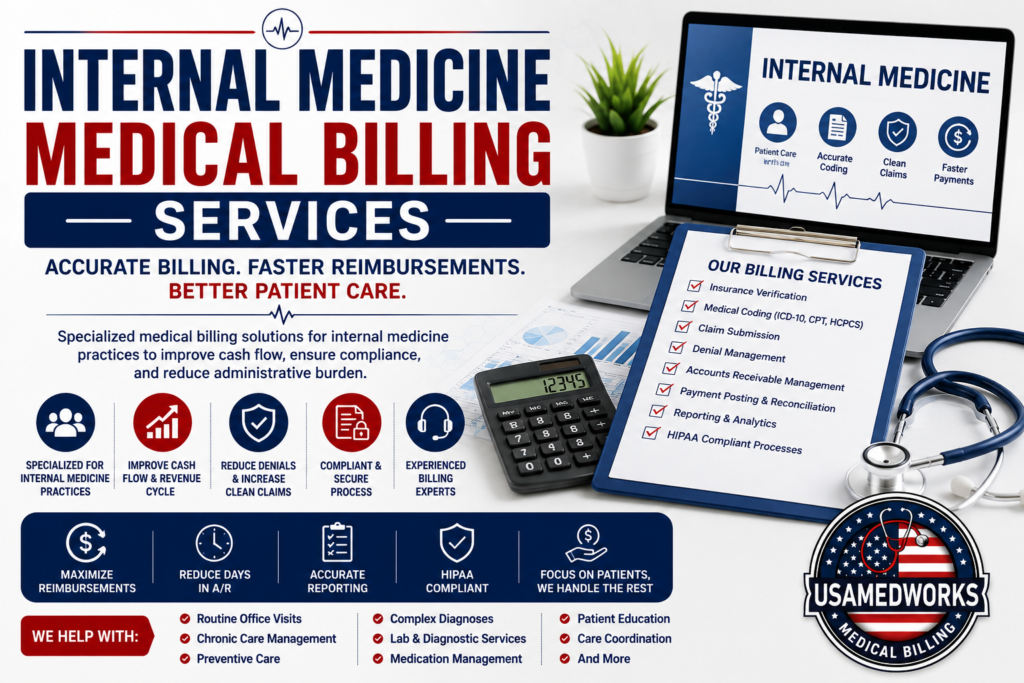
Internal medicine medical billing services handle the coding, claim submission, and denial management for internists treating adult patients with often complex, multi-condition needs. Because internal medicine visits are driven almost entirely by evaluation and management (E/M) coding and chronic disease management, getting those two areas right is what separates a practice with a healthy reimbursement rate from one chasing denials every month.
Key Takeaways
- Internal medicine billing revolves around E/M codes 99202–99215, leveled by medical decision-making complexity or time spent, not by diagnosis alone.
- Chronic Care Management (CPT 99490, 99439) and Annual Wellness Visit codes are commonly underbilled internal medicine services with strict time and documentation requirements.
- The most frequent internal medicine denial causes are E/M level mismatches, missing chronic condition documentation, and incorrect use of preventive-vs-problem-visit coding on the same encounter.
- Internal medicine is a high-volume, complex-documentation specialty — a small per-claim error rate compounds quickly across a busy panel.
- Dedicated internal medicine billing support reduces denial rates by matching documentation to the correct E/M level and tracking time-based codes accurately.
What Makes Internal Medicine Billing Different
Internal medicine doesn’t center on a small set of procedure codes the way a surgical specialty does — it centers on the evaluation and management (E/M) visit, repeated across a high volume of patients with overlapping chronic conditions: diabetes, hypertension, COPD, heart disease. That means correct billing depends heavily on documentation quality and the coder’s ability to translate medical decision-making complexity into the right E/M level, every single visit. A specialty like orthopedics might have a handful of high-value procedure codes to get right; internal medicine has to get thousands of nuanced E/M-level decisions right every month.
Core Internal Medicine CPT Codes
Evaluation and Management (New and Established Patients)
- 99202–99205 — new patient office visits, leveled by medical decision-making or total time.
- 99212–99215 — established patient office visits, the most frequently billed codes in an internal medicine practice.
- 99396–99397 — preventive medicine, established patient (ages 40-64 / 65+).
Chronic and Preventive Care
- 99490 — Chronic Care Management, first 20 minutes of clinical staff time per calendar month for patients with two or more chronic conditions.
- 99439 — each additional 20 minutes of Chronic Care Management beyond the first.
- G0439 — Medicare Annual Wellness Visit, subsequent visit.
- 99406/99407 — tobacco cessation counseling, when documented separately from the E/M visit.
Why E/M Level Selection Is the Biggest Risk Point
Since the 2021 E/M guideline changes, office visit levels are selected based on either the total time spent on the date of the encounter or the complexity of medical decision-making — not a checklist of history and exam elements. For internal medicine, where a single visit often touches three or four chronic conditions, this means the coder needs clear documentation of what was actually managed, not just discussed, to justify a higher-level code. Under-coding (billing a 99213 when the visit documentation actually supports a 99214) is common and quietly costs practices real revenue every month; over-coding without matching documentation is what draws payer audits.
Common Internal Medicine Denial Patterns
| Denial Pattern | Root Cause | Prevention |
|---|---|---|
| E/M level downcoded by payer | Documentation doesn’t clearly support the billed complexity level | Coder pre-submission review against MDM/time documentation standards |
| Chronic Care Management billed without qualifying time log | CCM codes require a documented time log per calendar month | Standardized time-tracking workflow for CCM-enrolled patients |
| Preventive and problem-oriented service billed same day without modifier 25 | A wellness visit and a separate problem addressed same day without the correct modifier | Modifier 25 checklist for any dual-purpose visit |
| Diagnosis code doesn’t support medical necessity | ICD-10 code too vague or not linked to the specific service billed | Coder cross-check of diagnosis specificity against payer medical necessity policy |
| Frequency limits exceeded | Certain preventive or monitoring services billed more often than payer allows | Track payer-specific frequency limits per service type |
How Specialty Billing Support Helps Internal Medicine Practices
Because internal medicine runs on volume and documentation-dependent E/M coding rather than a handful of high-value procedures, the return on getting billing right shows up as a steady reduction in denials across the whole panel, not a one-time fix. USA Medworks provides internal billing services to internal medicine practices with coders who track E/M documentation standards, manage Chronic Care Management billing correctly, and handle the appeals process for denials before they become lost revenue.
Frequently Asked Questions
What are the most common CPT codes used in internal medicine billing?
The most common are established-patient office visit codes 99212–99215, new-patient codes 99202–99205, and chronic care management codes 99490 and 99439 for patients with two or more chronic conditions.
How is the correct E/M level determined for an internal medicine visit?
Since the 2021 guideline changes, E/M level is based on either the total time spent on the date of the encounter or the complexity of medical decision-making documented in the note — not a checklist of history and exam elements.
What is Chronic Care Management billing and who qualifies?
Chronic Care Management (CPT 99490) covers non-face-to-face care coordination for patients with two or more chronic conditions expected to last at least 12 months. It requires at least 20 minutes of qualifying clinical staff time per calendar month, documented in a time log.
Why do internal medicine claims get downcoded by payers?
The most common reason is that the visit documentation doesn’t clearly support the complexity level billed — payers downcode when medical decision-making or time isn’t documented specifically enough to justify the code submitted.
When should an internal medicine practice outsource its billing?
Practices typically benefit from outsourcing when denial rates are rising, staff turnover is disrupting billing continuity, or the practice is growing faster than its in-house billing team can keep documentation-to-code accuracy consistent across a larger patient volume.