
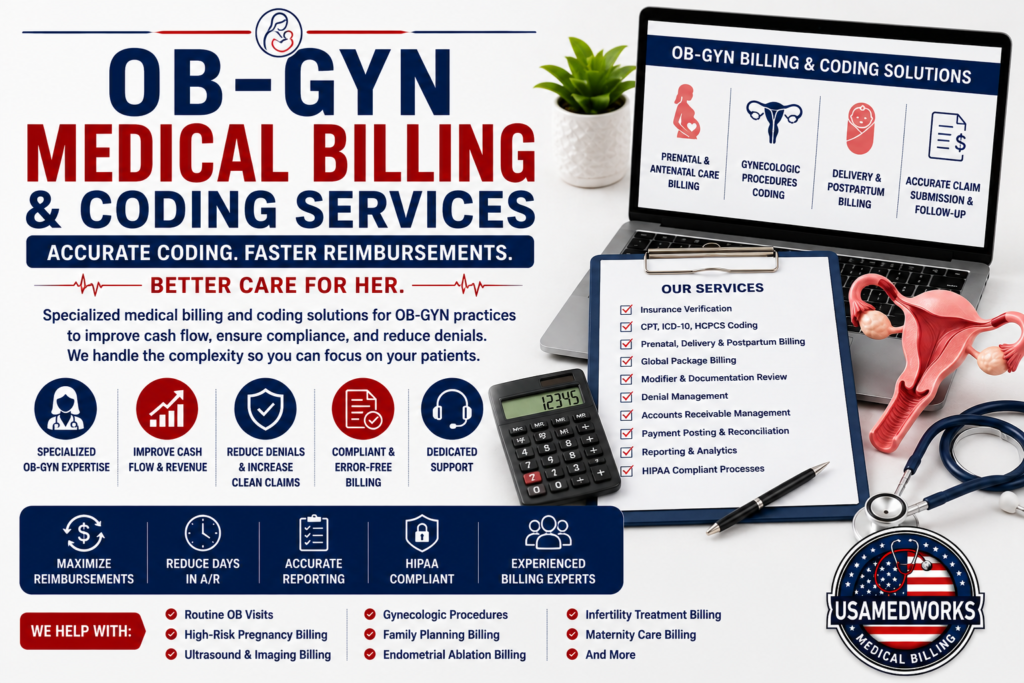
OB-GYN medical billing and coding is the process of translating obstetric and gynecologic care into CPT and ICD-10 codes, submitting clean claims, and managing the appeals when a payer denies them. It is one of the more complex specialties to bill correctly because a single pregnancy can span months of care billed under one global code, while gynecologic visits are billed encounter-by-encounter — and mixing up the two rules is one of the most common sources of denials.
Key Takeaways
- OB-GYN billing splits into two very different models: global maternity billing (one bundled code for the full pregnancy episode) and encounter-based gynecologic billing.
- The most common OB-GYN denial triggers are incorrect global period billing, missing modifiers (25, 59, 76), and mismatched diagnosis-to-procedure pairing.
- Correct use of modifier 25 (separately identifiable E/M service) and modifier 59 (distinct procedural service) resolves a large share of OB-GYN claim rejections.
- Prior authorization requirements for ultrasounds, non-invasive prenatal testing (NIPT), and certain surgical procedures vary significantly by payer.
- Specialty-trained billing staff who understand global maternity packages typically see fewer denials than general billing teams handling OB-GYN claims as one specialty among many.
How OB-GYN Billing Differs From General Medical Billing
Most outpatient specialties bill each visit as it happens. Obstetrics doesn’t work that way. Under global maternity billing, routine prenatal visits, delivery, and the postpartum visit are bundled into a single CPT code (such as 59400 for vaginal delivery including antepartum and postpartum care, or 59510 for cesarean delivery including antepartum and postpartum care) and billed once, typically after delivery. Gynecology, by contrast, is billed per encounter like any other specialty — annual wellness exams, problem visits, and procedures each generate their own claim.
The practical risk: a practice that treats every OB-GYN visit as a separate billable encounter will over-bill and trigger denials for services already included in the global package. A practice that bundles everything into the global code will under-bill for genuinely separate problems addressed during a pregnancy (a UTI, a fall, an unrelated gynecologic issue) that should be billed individually with the correct modifier.
Key CPT and ICD-10 Codes in OB-GYN Billing
Common OB-GYN CPT Codes
- 59400 / 59510 / 59610 / 59618 — global obstetric packages for vaginal, cesarean, and VBAC-related delivery, with and without antepartum/postpartum care included.
- 59425 / 59426 — antepartum care only (4-6 visits / 7+ visits), used when a patient transfers care mid-pregnancy.
- 59430 — postpartum care only.
- 76801 / 76805 — obstetric ultrasound, first trimester and second/third trimester.
- 58150, 58260, 58558 — common gynecologic surgical codes (hysterectomy variants, hysteroscopy with biopsy).
- 99213–99215 — evaluation and management codes for standard gynecologic office visits, leveled by complexity and time.
ICD-10 Considerations
Obstetric ICD-10 codes (the O00–O9A range) require a documented trimester and, in many cases, an episode-of-care character (initial vs. subsequent encounter) on every claim line. A missing or incorrect trimester/episode indicator is one of the most frequent, and most avoidable, causes of an OB-GYN claim rejection at the clearinghouse level — before it ever reaches the payer for adjudication.
The Modifiers That Make or Break an OB-GYN Claim
- Modifier 25 — appended when a significant, separately identifiable E/M service is performed on the same day as a procedure (for example, evaluating a new gynecologic complaint during what was scheduled as a procedure visit).
- Modifier 59 — appended to a procedure to indicate it is distinct from another procedure billed the same day, commonly used when an unrelated problem is addressed during prenatal care.
- Modifier 76 — appended when a procedure (such as a repeat ultrasound) is performed again by the same provider on the same day for medical necessity, not documentation convenience.
- Modifier 22 — appended for increased procedural complexity (a difficult delivery, extensive adhesions during surgery), and requires strong supporting documentation to survive payer review.
Missing or misapplied modifiers are, in our experience working across specialties, one of the single largest denial categories in OB-GYN billing — and one of the easiest to prevent with a coder who specializes in the service line rather than one covering it alongside a dozen other specialties.
Common OB-GYN Denial Reasons and How to Prevent Them
| Denial Reason | Why It Happens | How to Prevent It |
|---|---|---|
| Service bundled into global package | Billing a prenatal visit separately when it falls inside the global maternity period | Track the global period start/end per patient and flag any claim attempted inside it |
| Missing trimester/episode ICD-10 character | Obstetric diagnosis code submitted without the required 7th character | Build a coding checklist that enforces trimester and episode entry before claim submission |
| Missing modifier 25 or 59 | Separately identifiable service billed same-day as a procedure without the modifier | Coder review of same-day E/M + procedure combinations before submission |
| No prior authorization on file | Ultrasound, NIPT, or surgical procedure requiring payer pre-approval submitted without it | Verify payer-specific prior auth rules at scheduling, not at claim submission |
| Provider not credentialed with payer for the service | New OB-GYN associate not yet fully credentialed billing under their own NPI | Confirm active credentialing status before scheduling that provider’s claims to bill |
Why OB-GYN Practices Benefit From Specialty-Focused Billing Support
OB-GYN billing sits at the intersection of two very different billing logics — bundled obstetric packages and standard encounter-based gynecology — inside the same practice, often the same patient chart in the same month. A billing team that handles this specialty regularly catches global-period conflicts, modifier requirements, and payer-specific prior authorization rules before they become denials, rather than after. USA Medworks works with OB-GYN billing solutions for multi-specialty practices to keep claims clean the first time, track global maternity periods automatically, and manage the appeals process when a payer denies a claim that should have been paid.
Frequently Asked Questions
What is the difference between global maternity billing and encounter-based OB-GYN billing?
Global maternity billing bundles routine prenatal care, delivery, and the postpartum visit into a single CPT code billed once. Encounter-based billing, used for gynecology and any care outside the global package, bills each visit or procedure separately as it occurs.
What modifier is used when a separate problem comes up during a prenatal visit?
Modifier 25 is used when a significant, separately identifiable evaluation and management service is provided on the same day as a procedure or a visit that would otherwise be bundled, such as addressing a new complaint during a routine prenatal check.
Why do OB-GYN claims get denied for missing information on the diagnosis code?
Obstetric ICD-10 codes require a trimester indicator and an episode-of-care character (initial vs. subsequent encounter). Omitting either is a common, avoidable cause of claim rejection before the claim even reaches payer review.
Does every ultrasound during pregnancy need prior authorization?
It depends on the payer. Many plans require prior authorization for a second or third ultrasound in a pregnancy, or for advanced screening like NIPT, even though the first routine ultrasound may not require it — rules should be verified per payer at scheduling.
How can an OB-GYN practice reduce billing denials?
The most effective approach is specialty-focused billing support that tracks global maternity periods per patient, enforces modifier and ICD-10 checklists before submission, and verifies prior authorization requirements at the point of scheduling rather than after a denial arrives.