
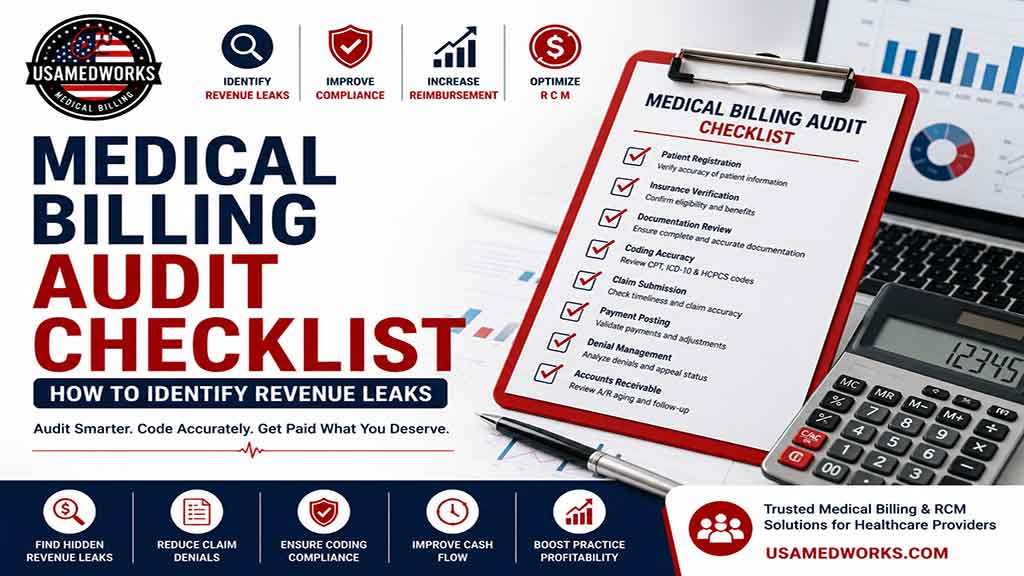
Medical Billing Audit Checklist: How to Identify Revenue Leaks
Financial success in healthcare depends on more than providing excellent patient care. Every medical practice, specialty clinic, urgent care center, behavioral health organization, and hospital must maintain an efficient revenue cycle management (RCM) process to ensure timely reimbursements and long-term profitability.
Unfortunately, many healthcare providers lose thousands—or even millions—of dollars each year because of unnoticed revenue leaks. Coding inaccuracies, incomplete documentation, eligibility verification errors, denied claims, delayed charge entry, and inefficient billing workflows can quietly reduce practice revenue without being immediately detected.
This is where a medical billing audit checklist becomes invaluable. Conducting regular medical billing audits helps healthcare organizations identify revenue leakage, improve coding compliance, strengthen reimbursement processes, and maximize collections.
Whether you manage a solo physician practice, multi-specialty clinic, ambulatory surgery center, behavioral health practice, or large healthcare organization, implementing a structured billing audit process is one of the most effective ways to improve financial performance while maintaining compliance with payer and regulatory requirements.
This comprehensive guide explains how to perform an effective medical billing audit, identify hidden revenue leaks, improve coding accuracy, reduce claim denials, and optimize your healthcare revenue cycle.
What Is a Medical Billing Audit?
A medical billing audit is a systematic review of a healthcare organization’s billing, coding, documentation, and reimbursement processes. The objective is to evaluate whether medical claims are accurate, compliant, and optimized for maximum reimbursement.
Medical billing audits evaluate every stage of the revenue cycle, including:
- Patient registration
- Insurance eligibility verification
- Prior authorization
- Medical documentation
- CPT coding
- ICD-10 diagnosis coding
- HCPCS coding
- Modifier usage
- Charge capture
- Claim submission
- Payment posting
- Denial management
- Accounts receivable follow-up
Healthcare organizations that perform routine billing audits are better equipped to detect billing inefficiencies before they become significant financial problems.
Why Medical Billing Audits Matter
Healthcare reimbursement is becoming increasingly complex. Medicare, Medicaid, and commercial insurance companies continue updating coding requirements, documentation standards, and reimbursement policies.
Even a small documentation or coding mistake can result in:
- Claim denials
- Delayed payments
- Reduced reimbursements
- Compliance risks
- Billing audits by payers
- Lost revenue
- Higher administrative costs
Regular medical billing audits help healthcare providers stay proactive rather than reactive.
Benefits of Medical Billing Audits
- Increase reimbursement accuracy
- Reduce claim denial rates
- Improve coding quality
- Identify workflow bottlenecks
- Strengthen HIPAA and CMS compliance
- Improve clean claim rates
- Reduce accounts receivable days
- Enhance provider documentation
- Increase overall practice profitability
What Is Revenue Leakage?
Revenue leakage refers to income that healthcare providers fail to collect because of avoidable billing, coding, or operational errors.
Many healthcare practices assume that revenue leakage only occurs when claims are denied. In reality, revenue can be lost at almost every stage of the revenue cycle.
Examples include:
- Missed charges
- Undercoding
- Duplicate claims
- Eligibility verification failures
- Missing prior authorizations
- Incorrect modifiers
- Incomplete documentation
- Delayed claim submission
- Poor denial follow-up
- Uncollected patient balances
Without routine audits, these small issues accumulate into significant financial losses over time.
Most Common Revenue Leaks in Medical Billing
| Revenue Leak | Financial Impact |
|---|---|
| Insurance eligibility errors | Denied claims |
| Prior authorization missing | Non-payment |
| Undercoding | Reduced reimbursement |
| Overcoding | Compliance risk |
| Modifier misuse | Claim rejection |
| Documentation deficiencies | Medical necessity denials |
| Charge capture errors | Lost revenue |
| Duplicate billing | Payment recoupment |
| Delayed claim filing | Timely filing denials |
| Poor AR follow-up | Cash flow reduction |
Medical Billing Audit Checklist
The following checklist can be used as an internal medical billing audit template for healthcare organizations.
| Audit Area | Review Questions |
|---|---|
| Patient Registration | Are demographics accurate? |
| Insurance Verification | Was eligibility confirmed before service? |
| Prior Authorization | Was authorization obtained when required? |
| Documentation | Does documentation support billed services? |
| CPT Coding | Are CPT codes accurate? |
| ICD-10 Coding | Do diagnosis codes support medical necessity? |
| Modifier Usage | Are modifiers correctly applied? |
| Charge Entry | Were all services billed? |
| Claim Submission | Were claims submitted on time? |
| Denial Management | Are denied claims analyzed and appealed? |
| Payment Posting | Were payments posted accurately? |
| Accounts Receivable | Are overdue balances followed up promptly? |
Completing this checklist quarterly can significantly improve billing accuracy and reduce preventable revenue loss.
Coding Audit Tips to Maximize Reimbursement
Medical coding directly affects reimbursement. Coding errors are among the leading causes of claim denials and compliance investigations.
Healthcare organizations should regularly review:
- CPT code accuracy
- ICD-10 diagnosis selection
- HCPCS coding
- E/M level selection
- Modifier usage
- Medical necessity documentation
- Procedure bundling
- NCCI edits
Common Coding Mistakes
- Undercoding office visits
- Upcoding services
- Using unspecified diagnosis codes unnecessarily
- Incorrect modifier 25 usage
- Modifier 59 overuse
- Billing duplicate procedures
- Incomplete procedure documentation
Routine coding audits improve both compliance and reimbursement performance.
Internal Audit Process for Medical Practices
An effective medical billing audit should follow a standardized workflow that evaluates each stage of the revenue cycle.
- Review patient registration accuracy.
- Verify insurance eligibility documentation.
- Confirm prior authorizations.
- Audit provider documentation.
- Validate CPT, ICD-10, and HCPCS coding.
- Review modifier usage.
- Evaluate charge capture processes.
- Review claim submission timelines.
- Analyze denied claims.
- Audit payment posting accuracy.
- Evaluate accounts receivable aging.
- Identify recurring revenue leakage trends.
Healthcare organizations that document audit findings and implement corrective action plans often see measurable improvements in reimbursement rates, denial reduction, and operational efficiency.
Warning Signs That Your Practice Needs a Billing Audit
If your organization is experiencing any of the following issues, a comprehensive medical billing audit should be performed immediately:
- Increasing denial rates
- Declining reimbursement revenue
- Growing accounts receivable balances
- Frequent payer audits
- Patient billing complaints
- Delayed payment cycles
- Coding inconsistencies
- High claim rejection percentages
- Staff turnover within the billing department
- Unexpected decreases in provider productivity revenue
These indicators often point to hidden operational inefficiencies that can be corrected through structured billing audits and revenue cycle optimization.
Medical Billing Compliance Best Practices
Compliance is one of the most important components of every medical billing audit. While increasing revenue is a primary objective, healthcare providers must also ensure that billing practices comply with federal regulations, payer policies, and coding guidelines.
Healthcare organizations should routinely evaluate their compliance with:
- HIPAA Privacy and Security Rules
- Centers for Medicare & Medicaid Services (CMS) billing guidelines
- National Correct Coding Initiative (NCCI) edits
- Office of Inspector General (OIG) compliance recommendations
- Current Procedural Terminology (CPT®) coding guidelines
- ICD-10-CM diagnosis coding standards
- Commercial payer reimbursement policies
Maintaining billing compliance helps reduce audit risk while improving reimbursement accuracy and protecting the practice from penalties.
Revenue Leakage Examples
Many revenue losses go unnoticed because they occur gradually throughout the revenue cycle. The following examples illustrate how common billing issues affect financial performance.
| Issue | Example | Impact |
|---|---|---|
| Eligibility Verification Failure | Inactive insurance coverage not identified | Claim denied |
| Missed Charge Capture | Procedure performed but never billed | 100% revenue loss |
| Undercoding | Billing 99213 instead of 99214 | Reduced reimbursement |
| Prior Authorization Missing | MRI performed without approval | Claim denied |
| Incorrect Modifier | Modifier 25 omitted | Procedure bundled |
| Documentation Deficiency | Medical necessity not supported | Claim rejected |
| AR Follow-Up Delays | Insurance balance aged over 120 days | Reduced collections |
Even a small percentage of missed revenue can significantly affect annual practice profitability.
Medical Billing KPIs to Monitor During Every Audit
A successful billing audit should include key performance indicators (KPIs) that measure the health of your revenue cycle.
| KPI | Target Benchmark |
|---|---|
| Clean Claim Rate | >95% |
| First-Pass Resolution Rate | >90% |
| Net Collection Rate | >95% |
| Days in Accounts Receivable | <40 Days |
| Denial Rate | <5% |
| Patient Collection Rate | Increasing Monthly |
| Charge Lag | Within 48 Hours |
Monitoring these KPIs allows healthcare organizations to identify trends before they become significant financial problems.
How Often Should Medical Billing Audits Be Performed?
The frequency of billing audits depends on practice size, specialty, patient volume, and payer mix.
| Practice Type | Recommended Audit Frequency |
|---|---|
| Solo Practice | Quarterly |
| Specialty Clinic | Quarterly |
| Multi-Specialty Group | Monthly & Quarterly |
| Behavioral Health Practice | Quarterly |
| Urgent Care Center | Monthly |
| Hospital Outpatient Department | Monthly |
Routine audits help organizations quickly identify operational issues and maintain optimal financial performance.
How Outsourced Medical Billing Services Improve Audit Results
Many healthcare organizations partner with professional medical billing companies to strengthen audit processes and improve overall revenue cycle performance.
Professional billing teams provide:
- Certified medical coders
- Dedicated denial management specialists
- Revenue cycle consultants
- Insurance eligibility verification
- Prior authorization management
- Payment posting accuracy
- Accounts receivable follow-up
- Detailed financial reporting
- Compliance monitoring
- Performance analytics
Outsourcing medical billing allows providers to focus on patient care while experienced billing professionals maximize reimbursement opportunities.
Internal Resources
- Medical Billing Services
- Revenue Cycle Management (RCM) Services
- Medical Billing & Coding Services
- Provider Credentialing Services
- Mental Health Billing Services
- Contact USA MedWorks
Helpful External Resources
- Centers for Medicare & Medicaid Services (CMS)
- Office of Inspector General (OIG)
- AAPC Medical Coding Resources
- American Medical Association (AMA)
Frequently Asked Questions
What is a medical billing audit?
A medical billing audit is a systematic review of billing, coding, documentation, reimbursement, and revenue cycle processes to identify errors, compliance risks, and opportunities to increase collections.
Why is a medical billing audit important?
Medical billing audits help reduce claim denials, improve coding accuracy, strengthen compliance, identify revenue leakage, and maximize reimbursement.
How often should medical billing audits be conducted?
Most healthcare organizations benefit from quarterly audits, while larger practices and urgent care centers may perform monthly reviews.
What causes revenue leakage in medical billing?
Common causes include coding errors, missed charges, prior authorization failures, eligibility verification mistakes, delayed claim submission, documentation deficiencies, and poor denial management.
Can outsourced medical billing companies perform audits?
Yes. Experienced medical billing companies provide comprehensive revenue cycle audits, coding reviews, denial analysis, compliance assessments, and performance reporting to improve financial outcomes.
Conclusion
A well-executed Medical Billing Audit Checklist is one of the most effective tools for identifying hidden revenue leaks, strengthening compliance, and improving financial performance. By regularly reviewing patient registration, insurance eligibility verification, medical coding, documentation, claim submission, denial management, and accounts receivable processes, healthcare providers can significantly increase clean claim rates and reduce preventable revenue loss.
Medical billing audits should not be viewed as a one-time compliance exercise. Instead, they should become a continuous quality improvement process that supports operational efficiency, regulatory compliance, and long-term practice growth.
Whether your organization is a private practice, specialty clinic, urgent care center, behavioral health provider, or multi-location healthcare group, proactive auditing helps uncover billing inefficiencies before they impact your bottom line.
At USA MedWorks, our experienced medical billing professionals help healthcare providers optimize every stage of the revenue cycle—from insurance eligibility verification and coding accuracy to denial management, AR follow-up, and compliance monitoring—allowing providers to maximize reimbursements while focusing on patient care.
Need Help Finding Hidden Revenue Leaks?
USA MedWorks offers comprehensive medical billing audits, coding reviews, denial management, revenue cycle management (RCM), credentialing, and end-to-end medical billing solutions tailored to healthcare providers across the United States.
Schedule your free revenue cycle assessment today and discover how much revenue your practice may be leaving behind.