
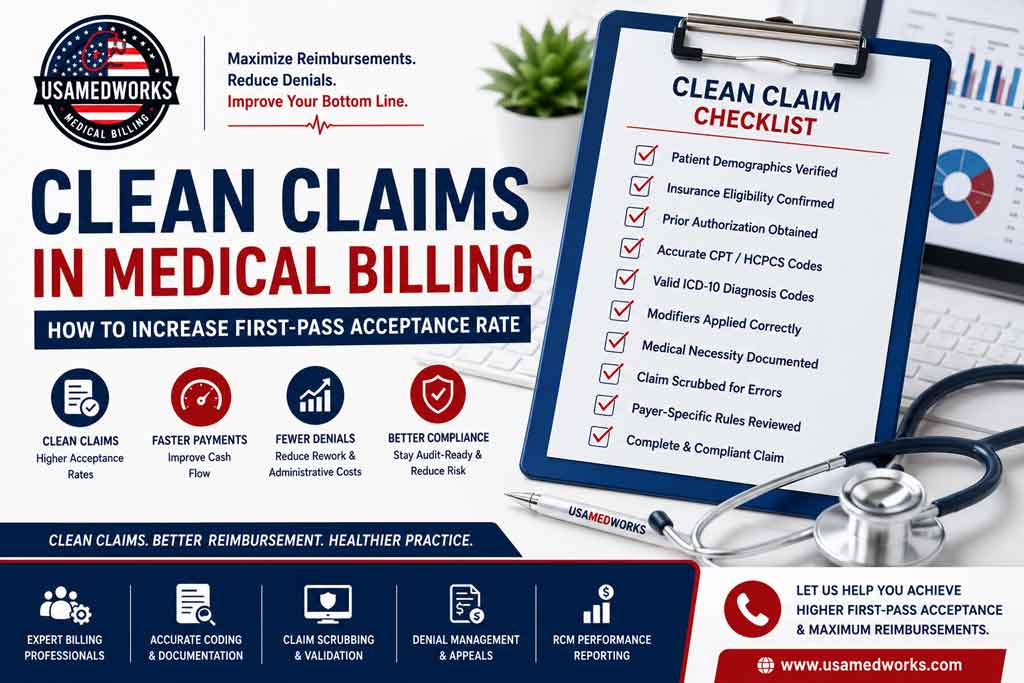
Clean Claims in Medical Billing: How to Increase First-Pass Acceptance Rate
One of the most important goals of every healthcare organization is submitting clean claims. A clean claim is a medical insurance claim that contains complete, accurate, and compliant information, allowing it to be processed and paid without requiring corrections, additional documentation, or manual intervention.
Unfortunately, many healthcare providers lose significant revenue every year because of claim rejections, denials, coding errors, eligibility issues, and incomplete documentation. These preventable mistakes increase administrative costs, delay reimbursements, and negatively affect cash flow.
Improving the first-pass acceptance rate is one of the most effective ways to strengthen your healthcare revenue cycle management (RCM). Practices that consistently submit clean claims experience faster reimbursements, lower denial rates, fewer accounts receivable days, and higher overall profitability.
This comprehensive guide explains what clean claims are, why they matter, how to create an effective clean claim workflow, and the practical steps healthcare providers can take to improve billing accuracy and maximize reimbursements.
What Is a Clean Claim in Medical Billing?
A clean claim is a healthcare insurance claim submitted with all required patient information, provider details, diagnosis codes, procedure codes, modifiers, and supporting documentation accurately completed according to payer guidelines.
When a claim is considered “clean,” insurance companies can process it without requesting additional information or returning it for corrections.
Clean claims generally include:
- Accurate patient demographics
- Verified insurance eligibility
- Correct provider information
- Complete CPT and HCPCS procedure codes
- Accurate ICD-10 diagnosis codes
- Appropriate medical billing modifiers
- Required prior authorization documentation
- Supporting clinical documentation
- Correct place of service (POS) codes
- HIPAA-compliant electronic submission
The cleaner the claim, the higher the probability of receiving reimbursement on the first submission.
Why Clean Claims Matter
Every rejected or denied claim represents delayed revenue and increased administrative work. Healthcare organizations spend considerable time correcting rejected claims, appealing denials, and resubmitting invoices that could have been processed correctly the first time.
Submitting clean claims offers several important benefits:
- Faster insurance reimbursements
- Higher first-pass acceptance rates
- Lower claim denial percentages
- Reduced administrative costs
- Improved provider productivity
- Better patient satisfaction
- Improved cash flow
- Lower accounts receivable balances
- Stronger compliance with payer requirements
Healthcare organizations that consistently maintain high clean claim rates typically experience stronger financial performance and more predictable revenue.
Understanding First-Pass Acceptance Rate
The first-pass acceptance rate (FPAR) measures the percentage of claims accepted and processed by insurance payers on the initial submission without requiring corrections or resubmission.
This metric is one of the most important revenue cycle management KPIs because it directly impacts reimbursement speed and administrative efficiency.
Formula
First-Pass Acceptance Rate = (Clean Claims Accepted ÷ Total Claims Submitted) × 100
Most high-performing medical practices aim for a first-pass acceptance rate above 95%.
Benefits of Increasing First-Pass Acceptance Rate
Improving first-pass acceptance rates creates measurable operational and financial benefits throughout the revenue cycle.
| Benefit | Business Impact |
|---|---|
| Faster Payments | Improved cash flow |
| Fewer Denials | Lower administrative workload |
| Reduced Rework | Higher staff productivity |
| Better Coding Accuracy | Improved reimbursement |
| Lower Accounts Receivable | Faster collections |
| Higher Patient Satisfaction | Accurate patient billing |
Every percentage point improvement in clean claim performance can significantly increase annual revenue for healthcare providers.
Top Reasons Medical Claims Are Rejected
Understanding why claims fail is the first step toward improving billing performance.
The most common claim rejection reasons include:
- Incorrect patient demographic information
- Insurance eligibility verification errors
- Missing prior authorization
- Incorrect CPT coding
- Invalid ICD-10 diagnosis codes
- Modifier omissions or misuse
- Duplicate claim submission
- Medical necessity documentation issues
- Expired insurance coverage
- Timely filing violations
- Provider credentialing issues
- Incorrect National Provider Identifier (NPI)
- Missing referring physician information
- Incorrect place of service code
Many of these errors can be prevented through standardized billing workflows and quality assurance processes.
Clean Claim Checklist
Every claim should pass the following verification checklist before submission.
| Checklist Item | Status |
|---|---|
| Patient demographics verified | ✓ |
| Insurance eligibility confirmed | ✓ |
| Prior authorization obtained | ✓ |
| CPT codes reviewed | ✓ |
| ICD-10 diagnosis validated | ✓ |
| Medical necessity documented | ✓ |
| Billing modifiers verified | ✓ |
| Provider credentials confirmed | ✓ |
| Claim scrubber completed | ✓ |
| Payer-specific edits reviewed | ✓ |
| Supporting documentation attached | ✓ |
Following this checklist before submitting every claim dramatically increases clean claim rates and reduces costly claim corrections.
Medical Billing Workflow for Clean Claims
Clean claims begin long before the claim is submitted. Every stage of the revenue cycle contributes to billing accuracy.
- Patient Scheduling
- Insurance Eligibility Verification
- Patient Registration
- Prior Authorization
- Medical Documentation
- CPT & ICD-10 Coding
- Charge Entry
- Claim Scrubbing
- Electronic Claim Submission
- Payment Posting
- Denial Management
- Accounts Receivable Follow-Up
A breakdown at any point in this workflow increases the likelihood of claim rejection or denial.
Best Practices for Submitting Clean Claims
Healthcare providers can significantly improve billing performance by implementing standardized best practices across their revenue cycle.
- Verify insurance eligibility before every visit.
- Obtain prior authorization when required.
- Ensure accurate patient registration.
- Use certified medical coders.
- Conduct routine coding audits.
- Review payer-specific billing requirements.
- Implement automated claim scrubbing software.
- Perform internal quality assurance reviews.
- Monitor denial trends monthly.
- Train billing staff regularly on coding updates.
Organizations that establish these processes often achieve higher first-pass acceptance rates while reducing costly billing errors.
Warning Signs Your Practice Has Poor Clean Claim Performance
If your organization experiences any of the following issues, your clean claim process may require immediate improvement:
- Increasing insurance denials
- High rejection rates
- Growing accounts receivable
- Frequent payer requests for additional documentation
- Slow reimbursement cycles
- Excessive claim corrections
- High billing staff workload
- Frequent coding errors
- Declining provider revenue
- Poor patient billing satisfaction
Monitoring these warning signs allows healthcare organizations to identify workflow problems before they significantly impact revenue.
KPI Benchmarks for Clean Claims in Medical Billing
Tracking key performance indicators (KPIs) is essential for evaluating the effectiveness of your medical billing process. These metrics help healthcare organizations identify inefficiencies, improve claim quality, and increase reimbursement rates.
Industry-leading healthcare organizations continuously monitor clean claim performance alongside other revenue cycle management metrics.
| KPI | Industry Benchmark | Goal |
|---|---|---|
| Clean Claim Rate | 95%+ | Higher is Better |
| First-Pass Acceptance Rate | 95-98% | Higher is Better |
| Claim Denial Rate | Below 5% | Lower is Better |
| Days in Accounts Receivable | 30-40 Days | Lower is Better |
| Net Collection Rate | 95%+ | Higher is Better |
| Charge Lag | Less than 48 Hours | Lower is Better |
| Rejection Rate | Below 3% | Lower is Better |
Regular KPI monitoring enables medical practices to make data-driven decisions and identify opportunities for continuous improvement.
How Claim Scrubbing Improves First-Pass Acceptance
Claim scrubbing is an automated quality assurance process that reviews medical claims for coding errors, missing information, payer-specific edits, and compliance issues before submission.
Modern claim scrubbing software checks for:
- Invalid CPT codes
- Incorrect ICD-10 diagnosis combinations
- Missing modifiers
- NCCI edit violations
- Duplicate claims
- Patient eligibility issues
- Provider credentialing errors
- Incorrect payer information
- Incomplete documentation requirements
Healthcare providers that implement automated claim scrubbing significantly reduce rejection rates while improving operational efficiency.
Denial Prevention Strategies
Preventing claim denials is significantly less expensive than correcting denied claims. A proactive denial prevention strategy strengthens revenue cycle performance and accelerates reimbursements.
Effective denial prevention includes:
- Real-time insurance eligibility verification
- Obtaining prior authorizations before treatment
- Routine coding audits
- Provider documentation improvement programs
- Payer-specific billing education
- Monthly denial trend analysis
- Continuous staff training
- Automated billing software validation
- Quality assurance reviews before submission
Organizations that focus on denial prevention often experience substantial improvements in clean claim performance.
Technology That Supports Clean Claims
Technology plays a vital role in reducing manual errors throughout the revenue cycle.
Healthcare organizations increasingly use:
- Electronic Health Records (EHR)
- Practice Management Software
- Claim Scrubbing Software
- Artificial Intelligence Coding Assistance
- Revenue Cycle Analytics
- Automated Eligibility Verification
- Electronic Prior Authorization Platforms
- Denial Management Dashboards
Integrating these technologies improves billing accuracy while reducing staff workload.
Common Payer-Specific Billing Tips
Medicare
- Verify medical necessity documentation.
- Review National Correct Coding Initiative (NCCI) edits.
- Ensure appropriate modifier usage.
Medicaid
- Verify eligibility before every visit.
- Review state-specific billing guidelines.
- Monitor authorization requirements.
Commercial Insurance
- Confirm payer-specific coding policies.
- Validate timely filing limits.
- Review coverage limitations before treatment.
How Outsourced Medical Billing Improves Clean Claim Rates
Professional medical billing companies specialize in maximizing first-pass acceptance rates by implementing standardized billing workflows, quality assurance processes, and continuous compliance monitoring.
Outsourcing medical billing services provides healthcare organizations with:
- Certified medical coders
- Experienced billing specialists
- Real-time insurance verification
- Prior authorization management
- Claim scrubbing technology
- Denial management specialists
- Accounts receivable follow-up
- Revenue cycle reporting
- Compliance monitoring
- Performance analytics
Many practices experience measurable improvements in reimbursement speed and cash flow after partnering with an experienced revenue cycle management company.
Internal Resources
- Medical Billing Services
- Revenue Cycle Management Services
- Medical Billing & Coding Services
- Provider Credentialing Services
- Mental Health Billing Services
- Contact USA MedWorks
Helpful External Resources
- Centers for Medicare & Medicaid Services (CMS)
- AAPC Medical Coding Resources
- American Medical Association (AMA)
- Office of Inspector General (OIG)
Frequently Asked Questions
What is a clean claim in medical billing?
A clean claim is a medical insurance claim that contains accurate, complete, and compliant information, allowing the payer to process and reimburse it without requiring corrections or additional documentation.
What is a good first-pass acceptance rate?
Most high-performing healthcare organizations maintain a first-pass acceptance rate between 95% and 98%.
Why are medical claims rejected?
Claims are commonly rejected because of coding errors, insurance eligibility issues, missing authorizations, incorrect modifiers, incomplete documentation, duplicate claims, or inaccurate patient information.
How can healthcare providers improve clean claim rates?
Healthcare providers can improve clean claim rates by verifying insurance eligibility, obtaining prior authorization, using certified medical coders, implementing claim scrubbing software, and conducting regular billing audits.
Does outsourcing medical billing improve reimbursement?
Yes. Professional medical billing companies improve billing accuracy, reduce denials, accelerate reimbursements, and strengthen overall revenue cycle management performance.
Conclusion
Submitting clean claims is one of the most effective ways to improve healthcare financial performance. Every clean claim reduces administrative costs, accelerates reimbursements, improves provider productivity, and strengthens the overall revenue cycle.
Healthcare organizations that invest in eligibility verification, coding accuracy, documentation improvement, claim scrubbing, denial prevention, and continuous staff education consistently achieve higher first-pass acceptance rates and lower denial percentages.
Improving clean claim performance is not simply a billing objective—it is a strategic investment in the long-term financial health of every healthcare organization.
USA MedWorks helps healthcare providers nationwide optimize every stage of the revenue cycle through professional medical billing, coding, insurance verification, denial management, credentialing, and revenue cycle management services.
Ready to Improve Your Clean Claim Rate?
Partner with USA MedWorks to reduce claim denials, increase first-pass acceptance rates, improve reimbursements, and maximize your healthcare revenue cycle performance.