
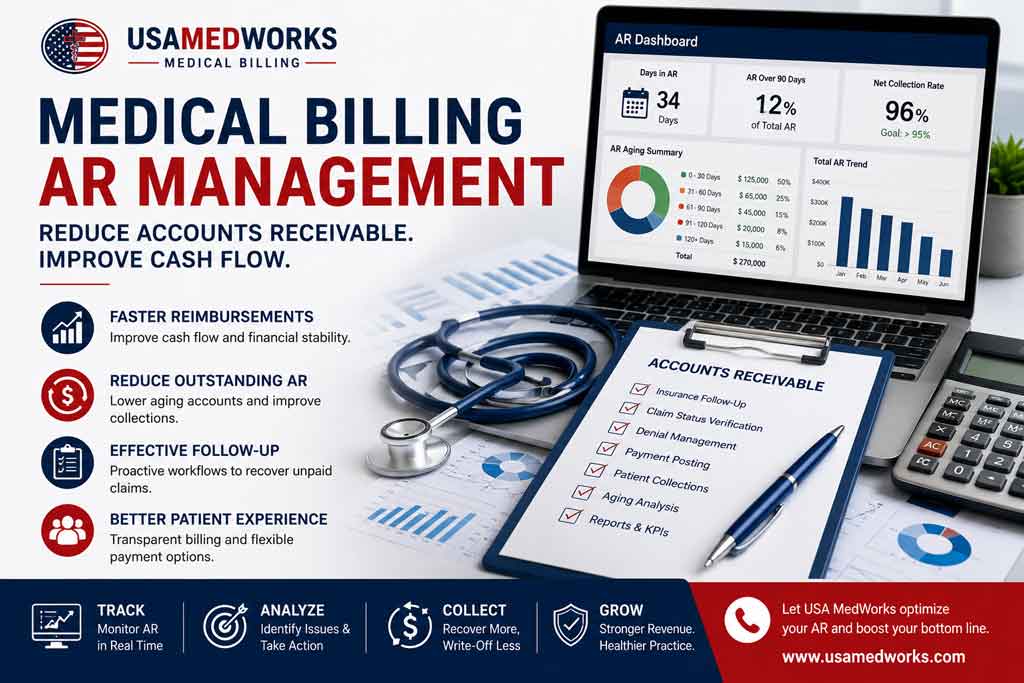
Medical Billing AR Management: How to Reduce Accounts Receivable & Improve Cash Flow
Accounts Receivable (AR) Management is one of the most important components of healthcare revenue cycle management (RCM). Even practices with excellent providers, accurate coding, and high patient volumes can experience financial challenges if insurance claims remain unpaid or patient balances continue to age.
Healthcare providers across the United States lose millions of dollars annually because of ineffective medical billing AR management. Delayed insurance follow-up, denied claims, inaccurate payment posting, poor collection strategies, and aging accounts receivable significantly reduce cash flow and increase administrative costs.
Implementing a structured Medical Billing AR Management process enables healthcare organizations to accelerate reimbursements, improve collections, reduce bad debt, and maintain a healthy revenue cycle.
This comprehensive guide explains how AR management works, why it matters, how to monitor aging accounts, improve collections, reduce insurance denials, and maximize healthcare reimbursements.
What Is Medical Billing AR Management?
Medical Billing Accounts Receivable (AR) Management is the process of tracking, monitoring, collecting, and resolving outstanding balances owed to healthcare providers by insurance companies and patients.
Every unpaid claim enters the Accounts Receivable system until payment is received or the balance is resolved.
Medical billing AR management includes:
- Insurance claim follow-up
- Patient balance collections
- Payment posting
- Denial management
- Appeals processing
- Underpayment recovery
- Accounts receivable reporting
- Collection analytics
- Revenue cycle optimization
A strong AR management process helps providers receive payments faster while minimizing revenue leakage.
Why Medical Billing AR Management Matters
Healthcare organizations often focus heavily on coding and claim submission but overlook the importance of timely collections. Unfortunately, submitting claims is only one part of the revenue cycle.
Without proactive AR management, even correctly submitted claims may remain unpaid for months due to payer delays, denials, missing documentation, or insufficient follow-up.
Effective medical billing AR management helps:
- Improve cash flow
- Reduce outstanding balances
- Accelerate insurance reimbursements
- Increase net collection rates
- Reduce claim write-offs
- Improve patient collections
- Strengthen overall revenue cycle management
- Identify billing process inefficiencies
Healthcare providers with well-managed AR departments generally maintain healthier financial performance and lower operational costs.
Common Causes of High Accounts Receivable
Many healthcare organizations experience growing AR balances because of avoidable operational issues.
The most common causes include:
- Claim denials
- Insurance eligibility errors
- Missing prior authorizations
- Coding mistakes
- Delayed claim submission
- Slow insurance follow-up
- Incorrect payment posting
- Patient billing delays
- Provider credentialing issues
- Poor denial management processes
- Incomplete medical documentation
- Lack of AR reporting
Identifying these issues early helps practices improve collections and reduce aging receivables.
Understanding AR Aging Buckets
Accounts Receivable aging reports categorize unpaid balances based on the number of days they have remained outstanding.
Monitoring aging buckets allows billing teams to prioritize follow-up activities before claims exceed timely filing or appeal deadlines.
| AR Aging Bucket | Status | Recommended Action |
|---|---|---|
| 0–30 Days | Current | Monitor claim processing |
| 31–60 Days | Moderate Risk | Verify payer status |
| 61–90 Days | High Risk | Immediate insurance follow-up |
| 91–120 Days | Critical | Escalate claims and begin appeals |
| 120+ Days | Severe Risk | Final collection efforts or write-off review |
Most successful healthcare organizations strive to keep the majority of outstanding receivables within the 0–30 day aging bucket.
Insurance AR vs Patient AR
Medical billing accounts receivable generally fall into two categories.
Insurance Accounts Receivable
Insurance AR consists of unpaid balances owed by commercial insurance companies, Medicare, Medicaid, or managed care organizations.
Insurance AR typically requires:
- Claim status verification
- Denial analysis
- Appeals
- Payment correction requests
- Underpayment recovery
Patient Accounts Receivable
Patient AR includes deductibles, copayments, coinsurance, and self-pay balances.
Effective patient collection strategies include:
- Upfront payment collection
- Payment plans
- Electronic payment options
- Automated reminders
- Financial counseling
Medical Billing Collection Strategies
Reducing outstanding AR requires a structured collection strategy supported by consistent follow-up and accurate reporting.
Best practices include:
- Verify insurance eligibility before every visit.
- Collect patient copays during check-in.
- Submit claims within 24–48 hours.
- Review claim acceptance daily.
- Monitor denied claims immediately.
- Appeal underpaid or denied claims promptly.
- Contact payers before claims reach 60 days.
- Offer patient payment plans.
- Automate billing reminders.
- Review AR aging reports weekly.
Organizations that follow standardized collection strategies consistently improve cash flow while reducing write-offs.
Medical Billing AR Follow-Up Workflow
Timely follow-up is the foundation of successful AR management. Every outstanding claim should follow a structured workflow until payment is received.
- Submit clean claims electronically.
- Confirm payer acceptance.
- Review clearinghouse reports.
- Track unpaid claims.
- Contact insurance carriers after 30 days.
- Investigate denial reasons.
- Correct billing errors.
- Submit appeals when necessary.
- Post payments accurately.
- Bill patient responsibility.
- Continue follow-up until account resolution.
A disciplined AR follow-up workflow significantly reduces aging balances and improves reimbursement timelines.
Best Practices for Reducing AR Days
Healthcare organizations seeking to reduce Days in Accounts Receivable should focus on operational efficiency throughout the revenue cycle.
- Improve clean claim rates.
- Strengthen insurance eligibility verification.
- Reduce coding errors.
- Obtain prior authorizations before services.
- Implement claim scrubbing software.
- Monitor payer turnaround times.
- Conduct monthly billing audits.
- Track denial trends.
- Automate insurance follow-up tasks.
- Provide ongoing staff education.
These strategies help providers reduce reimbursement delays while maximizing collections.
Warning Signs Your Practice Has AR Problems
If your practice experiences any of the following issues, your Accounts Receivable management process may require immediate improvement:
- AR over 90 days continues to increase.
- High claim denial percentages.
- Low net collection rates.
- Increasing insurance write-offs.
- Frequent patient billing complaints.
- Large number of unresolved appeals.
- Slow payment posting.
- Growing outstanding insurance balances.
- Declining monthly cash flow.
- Inconsistent billing reports.
Recognizing these warning signs early allows healthcare organizations to correct operational issues before they impact profitability.
Medical Billing AR KPI Dashboard
Monitoring key performance indicators (KPIs) helps healthcare providers measure the effectiveness of their Accounts Receivable (AR) management process. A KPI dashboard provides actionable insights into reimbursement trends, payer performance, collection efficiency, and overall revenue cycle health.
Successful medical practices review AR reports monthly to identify bottlenecks, reduce outstanding balances, and improve cash flow.
| KPI | Industry Benchmark | Target |
|---|---|---|
| Days in Accounts Receivable | 30–40 Days | Lower is Better |
| AR Over 90 Days | Less than 15% | Lower is Better |
| Net Collection Rate | 95%+ | Higher is Better |
| First-Pass Claim Acceptance | 95–98% | Higher is Better |
| Claim Denial Rate | Below 5% | Lower is Better |
| Average Payment Time | Under 30 Days | Lower is Better |
| Bad Debt Percentage | Below 2% | Lower is Better |
Tracking these KPIs regularly enables healthcare providers to identify collection issues early and implement targeted improvement strategies.
Accounts Receivable Reporting Metrics
AR reports provide valuable insights into the financial health of a medical practice. Healthcare administrators should review these reports regularly to identify payer trends, monitor outstanding claims, and evaluate staff performance.
Important AR reports include:
- Insurance Aging Report
- Patient Aging Report
- Denied Claims Report
- Appeals Status Report
- Payment Posting Report
- Underpayment Analysis
- Collection Rate Report
- Payer Performance Report
- Monthly Revenue Summary
- Cash Flow Analysis
Using data-driven reporting allows healthcare organizations to make informed financial decisions and continuously optimize revenue cycle performance.
Technology and Automation in Medical Billing AR Management
Modern medical billing software and automation tools have transformed Accounts Receivable management by reducing manual tasks, improving billing accuracy, and accelerating collections.
Healthcare providers can benefit from:
- Automated insurance eligibility verification
- Electronic claim submission
- Claim scrubbing software
- Real-time denial alerts
- Electronic remittance advice (ERA)
- Automated payment posting
- Patient payment portals
- Automated billing reminders
- Revenue cycle dashboards
- AI-powered billing analytics
Automation helps reduce administrative costs while allowing billing teams to focus on higher-value activities such as denial resolution and revenue optimization.
Benefits of Outsourcing Medical Billing AR Management
Many healthcare organizations outsource their Accounts Receivable management to experienced medical billing companies to improve collections and strengthen financial performance.
Professional AR management services provide:
- Dedicated AR specialists
- Insurance claim follow-up
- Denial management and appeals
- Payment posting accuracy
- Underpayment recovery
- Patient balance collections
- Monthly KPI reporting
- Compliance monitoring
- Revenue cycle consulting
- Reduced administrative burden
Outsourcing enables healthcare providers to improve reimbursement rates, reduce outstanding receivables, and focus more time on patient care.
Common Medical Billing AR Mistakes to Avoid
Many practices unintentionally increase their AR balances because of avoidable operational mistakes.
- Waiting too long to follow up on unpaid claims.
- Ignoring denied claims.
- Not reviewing payer contracts.
- Delaying payment posting.
- Submitting inaccurate claims.
- Poor documentation practices.
- Not collecting patient balances at check-in.
- Failing to monitor aging reports.
- Missing timely filing deadlines.
- Inadequate staff training.
A proactive AR management strategy minimizes these risks and improves overall practice profitability.
Internal Resources
- Medical Billing Services
- Revenue Cycle Management (RCM) Services
- Medical Billing & Coding Services
- Provider Credentialing Services
- Mental Health Billing Services
- Request a Free Consultation
Helpful External Resources
- Centers for Medicare & Medicaid Services (CMS)
- AAPC Medical Coding & Billing Resources
- American Medical Association (AMA)
- Office of Inspector General (OIG)
Frequently Asked Questions
What is Medical Billing AR Management?
Medical Billing AR Management is the process of monitoring, collecting, and resolving outstanding insurance and patient balances to improve reimbursements and maintain healthy cash flow.
What are AR aging buckets?
AR aging buckets categorize unpaid balances based on the number of days they have remained outstanding, helping billing teams prioritize collections and follow-up activities.
What is a good Days in AR benchmark?
Most healthcare organizations aim to keep Days in Accounts Receivable between 30 and 40 days, with less than 15% of AR exceeding 90 days.
How can practices improve AR collections?
Healthcare providers can improve collections through timely insurance follow-up, accurate coding, eligibility verification, denial management, patient payment plans, and regular AR reporting.
Should medical practices outsource AR management?
Outsourcing AR management can improve collection rates, reduce administrative costs, strengthen denial management, and accelerate reimbursements by leveraging experienced billing professionals.
Conclusion
Effective Medical Billing AR Management is essential for maintaining a healthy healthcare revenue cycle. By monitoring AR aging buckets, tracking key performance indicators, implementing proactive collection strategies, and following structured insurance follow-up workflows, healthcare providers can significantly reduce outstanding balances and improve cash flow.
Combining accurate coding, clean claim submission, timely denial management, payment posting, and continuous AR monitoring creates a stronger financial foundation for medical practices of every size.
Healthcare organizations that invest in efficient AR management not only increase reimbursements but also enhance operational efficiency, improve patient satisfaction, and strengthen long-term financial stability.
USA MedWorks provides comprehensive medical billing, Accounts Receivable management, denial management, revenue cycle management, insurance follow-up, and credentialing services to help healthcare providers maximize collections and reduce aging receivables.
Need Help Reducing Outstanding Accounts Receivable?
Partner with USA MedWorks to improve collections, reduce AR days, strengthen your revenue cycle, and maximize reimbursements through professional medical billing and Accounts Receivable management services.